On this page
- How to calculate cubic yards
- How to use the cubic yard calculator
- Cubic yard formulas for other shapes
- What one cubic yard covers
- How much does a cubic yard weigh?
- Cubic yards to tons and back
- Cubic yards of common landscape materials
- Bags per cubic yard
- Ordering by the cubic yard
- Cubic yards, cubic feet and cubic meters
- Common cubic yard mistakes
- Your cubic yards in one step
- Frequently asked questions
How to calculate cubic yards
Get the length, width and depth in feet, multiply them for cubic feet, then divide by 27. A cubic yard is a cube 3 ft on each side: 3 × 3 × 3 = 27 cubic feet.
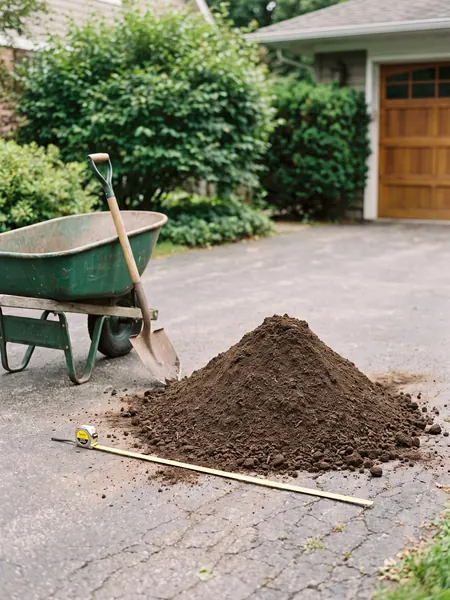
Worked example: a 10 × 10 ft bed 3 inches deep. The depth is 3 ÷ 12 = 0.25 ft, so the volume is 10 × 10 × 0.25 = 25 cubic feet, and 25 ÷ 27 = 0.93 cubic yards.
Bulk mulch, soil, gravel, sand and ready-mix concrete are all sold by the cubic yard, which is why this one conversion comes up in almost every yard project.
How to use the cubic yard calculator
The cubic yard calculator runs the formula above and shows each step in "How we calculated this" and in the PDF report.
Step 1: Choose the shape and enter the size
Rectangle or square: enter each dimension, the length and width, in feet. Circle: enter the diameter. For a triangle, a path with curves or an L-shape, get the square footage first with the square footage calculator and use a square of the same area.
Step 2: Enter the depth in inches or feet
Most depths are given in inches, so the calculator divides by 12 for you. Choose feet for deep fills and excavations. Depth changes the result more than anything: going from 3 to 4 inches adds a third to the order.
Step 3: Pick the material in the cubic yard calculator
Choose mulch, topsoil, sand, gravel or concrete to add the weight in tons, using The Calculator Site's weight per cubic yard. Leave it on "Volume only" if you just need yards.
Step 4: Add the price per cubic yard and the number of areas
Enter your supplier's price per yard for the total cost, and the number of identical areas, for example four beds of the same size, to multiply the volume.
Cubic yard formulas for other shapes
- Rectangle or slab: length × width × depth ÷ 27.
- Circle: π × radius² × depth ÷ 27. A round bed 12 ft across, 3 in deep: 3.1416 × 36 × 0.25 = 28.3 cu ft = 1.05 yd³.
- Triangle: base × height ÷ 2 × depth ÷ 27.
- Post hole or column: π × radius² × depth ÷ 27. A hole 12 in across and 3 ft deep holds 2.36 cu ft, 0.087 yd³.
What one cubic yard covers
Coverage = 324 ÷ depth in inches, in square feet. Use it to sanity-check any quote.
| Depth | Area covered by 1 yd³ | Square yards |
|---|---|---|
| 1 in | 324 sq ft | 36.0 sq yd |
| 2 in | 162 sq ft | 18.0 sq yd |
| 3 in | 108 sq ft | 12.0 sq yd |
| 4 in | 81 sq ft | 9.0 sq yd |
| 6 in | 54 sq ft | 6.0 sq yd |
| 12 in | 27 sq ft | 3.0 sq yd |
How much does a cubic yard weigh?
Weight per cubic yard, as listed by The Calculator Site. Moisture changes it a lot: wet sand and gravel are about 20% heavier than dry. Your supplier's figure is the one to use for trailers and truck limits.
| Material | Weight per cubic yard | US tons |
|---|---|---|
| Bark mulch | 506 lb | 0.25 ton |
| Wood chips | 674 lb | 0.34 ton |
| Crushed limestone | 2,430 lb | 1.22 tons |
| Topsoil | 2,700 lb | 1.35 tons |
| Sand, dry | 2,700 lb | 1.35 tons |
| Sand, wet | 3,240 lb | 1.62 tons |
| Gravel, dry (¼ to 2 in) | 2,835 lb | 1.42 tons |
| Gravel, wet (¼ to 2 in) | 3,375 lb | 1.69 tons |
| Concrete (solid slab) | 3,915 lb | 1.96 tons |
Cubic yards to tons and back
Tons = cubic yards × tons per yard; cubic yards = tons ÷ tons per yard. A 12 × 20 ft area of dry sand 4 inches deep is 2.96 yd³, about 4 tons. Quarries sell stone by the ton, landscape yards often by the yard, so convert before you compare quotes.
Cubic yards of common landscape materials
- Mulch: 2 to 4 in deep over beds; a 2 cu ft bag is 1/13.5 of a yard. See the mulch calculator.
- Topsoil and fill: sold by the yard, heavier when wet, and fill settles. See the topsoil calculator.
- Gravel and sand: planned in yards, often sold by the ton. See the gravel calculator.
- Concrete: ordered by the yard from a ready-mix plant, or in bags: QUIKRETE gives about 0.6 cu ft per 80 lb bag, 45 bags per yard. See the concrete calculator.
Bags per cubic yard
| Bag size | Bags per cubic yard |
|---|---|
| 0.5 cu ft | 54 |
| 1 cu ft | 27 |
| 1.5 cu ft | 18 |
| 2 cu ft | 13.5 |
| 3 cu ft | 9 |
Past about 2 cubic yards, bulk delivery is usually cheaper than bags, but compare the delivery fee and the minimum order.
Ordering by the cubic yard
Round up. Suppliers load in half or whole yards, and loose soil, fill and gravel settle or compact once spread. Ask how many yards their truck carries, what the minimum load is, and whether the price per cubic yard includes delivery.
Measure the depth where it matters
For a base or a fill, measure the finished, compacted depth and order a little extra for compaction. For mulch and topsoil over a bed, measure at the shallow end so the thin spots are covered.
Cubic yards, cubic feet and cubic meters
- 1 cubic yard = 27 cubic feet = 46,656 cubic inches.
- 1 cubic yard = 0.7646 cubic meters; 1 cubic meter = 1.308 cubic yards.
- 1 cubic foot = 1,728 cubic inches = 7.48 US gallons.
Common cubic yard mistakes
- Forgetting to convert inches. 3 inches is 0.25 ft, not 3 ft: that error makes the order 12 times too big.
- Dividing by 9 instead of 27. 9 turns square feet into square yards, not cubic feet into cubic yards.
- Ordering the exact volume. Settling and uneven ground eat material; round up.
Your cubic yards in one step
Enter the size and the depth, pick the material, and the cubic yard calculator returns cubic yards, cubic feet, cubic meters and tons, with the cost at your price per yard. Round up, confirm the weight with your supplier, and download the PDF report to take with you.
Frequently asked questions
How do I calculate cubic yards?
Multiply length × width × depth in feet to get cubic feet, then divide by 27. A 10 × 10 ft area 3 inches deep: 10 × 10 × 0.25 = 25 cu ft ÷ 27 = 0.93 cubic yards.
How many square feet does a cubic yard cover?
At 1 inch deep, a cubic yard covers 324 sq ft. At 2 inches it covers 162 sq ft, at 3 inches 108 sq ft, at 4 inches 81 sq ft and at 6 inches 54 sq ft.
How many cubic feet are in a cubic yard?
27. A yard is 3 feet, so a cubic yard is 3 × 3 × 3 = 27 cubic feet, or 46,656 cubic inches, about 0.765 cubic meters.
How much does a cubic yard weigh?
It depends on the material. The Calculator Site lists bark mulch at about 506 lb, topsoil and dry sand at about 2,700 lb (1.35 tons), dry gravel at about 2,835 lb and a solid concrete slab at about 3,915 lb per cubic yard.
How many bags make a cubic yard?
27 cubic feet divided by the bag size: 13.5 bags of 2 cu ft, 27 bags of 1 cu ft or 54 bags of 0.5 cu ft. For concrete, QUIKRETE gives about 0.6 cu ft per 80 lb bag, so 45 bags per yard.
How do I convert cubic yards to tons?
Multiply the cubic yards by the material's weight per yard in tons. 3 yd³ of dry sand at 1.35 tons per yard is about 4 tons. Pick the material in the cubic yard calculator and it does this.
Should I round up my order?
Yes. Suppliers deliver in set increments, and soil and fill settle or compact after spreading. Round up to the next half or whole yard, and ask your supplier about the minimum order.
Sources