On this page
- How to convert lot size to acres
- How to use the lot size to acres calculator
- Common lot sizes in square feet and acres
- Irregular, corner and pie-shaped lots
- How lot size is written on plats, deeds and listings
- Lot coverage, setbacks and zoning
- How to measure a lot
- Your lot size in acres
- Frequently asked questions
How to convert lot size to acres
Find the lot size in square feet (frontage × depth for a rectangular lot), then divide by 43,560 to get acres. A 75 × 140 ft lot is 10,500 sq ft, or 0.24 acres.
One acre is 43,560 square feet, the definition in NIST Handbook 44, so the conversion is exact. What is not exact is the measurement: lots are rarely perfect rectangles, which is why the calculator also handles trapezoids and any four-sided lot.
How to use the lot size to acres calculator
Three inputs and you have the lot size in square feet, acres, square yards and square meters, with lot coverage if you add the buildings.
Step 1: Choose the lot shape
Rectangle for a standard lot, trapezoid when the front and back lines are parallel but of different widths, and "4 sides + diagonal" for any other four-sided lot, including corner and pie-shaped lots.
Step 2: Enter the measurements in feet
Frontage is the width along the street; depth is the distance from the front line to the back line. For an irregular lot, enter all four sides and the diagonal from the front-left corner to the back-right corner.
Step 3: Add the footprint in the lot size to acres calculator
Enter the footprint of the house, garage and sheds in square feet. The result adds the lot coverage percentage that zoning codes use, and puts everything in the PDF report.
Common lot sizes in square feet and acres
Typical residential lots, written the way plats write them: frontage × depth.
| Lot (frontage × depth) | Square feet | Acres |
|---|---|---|
| 50 × 100 ft | 5,000 | 0.115 |
| 60 × 120 ft | 7,200 | 0.165 |
| 75 × 100 ft | 7,500 | 0.172 |
| 80 × 125 ft | 10,000 | 0.230 |
| 75 × 140 ft | 10,500 | 0.241 |
| 100 × 150 ft | 15,000 | 0.344 |
| 100 × 200 ft | 20,000 | 0.459 |
| 150 × 290.4 ft | 43,560 | 1.000 |
A quarter-acre lot is 10,890 sq ft, a half acre 21,780 sq ft. For example, a lot 150 ft wide needs to be 290.4 ft deep to make one full acre of land.
Irregular, corner and pie-shaped lots
Cul-de-sac, corner and hillside lots are rarely rectangles. Length × width on a skewed lot can miss by hundreds of square feet, so use the shape that matches it.
Trapezoid lots
When the front and back property lines are parallel but different widths: (front + back) ÷ 2 × depth. A lot 60 ft at the street, 90 ft at the back and 140 ft deep is 10,500 sq ft, or 0.24 acres.
Any four-sided lot: sides plus a diagonal
Measure the four sides and one diagonal. The diagonal splits the lot into two triangles, and Heron's formula gives each area from its three sides. Sides of 75, 142, 80 and 138 ft with a 161 ft diagonal give 10,844 sq ft, or 0.25 acres.
Lots with more than four sides
Split the lot into four-sided pieces and triangles, measure each, and add them. The square footage calculator adds several sections at once; the acreage calculator handles large rural parcels in chains, yards or meters.
How lot size is written on plats, deeds and listings
A plat map is the recorded drawing of a subdivision. It shows each lot's dimensions, often as "75 x 140" with frontage first, and sometimes the area. Deeds describe the same lot by its lot and block number or by metes and bounds.
Listings on an MLS usually give lots under an acre in square feet and larger lots in acres. Convert both to the same unit before you compare prices per square foot or per acre.
The recorded size governs
The plat, your deed, a boundary survey or the county assessor's record gives the official lot size. Your tape measurements can differ, and only a licensed surveyor can set property lines for a sale, a fence on the line or a permit.
Lot coverage, setbacks and zoning
Lot coverage is the building footprint divided by the lot size: 2,200 sq ft of house and garage on a 10,500 sq ft lot is 21%. Zoning codes often cap it, and some count patios, driveways and pools too.
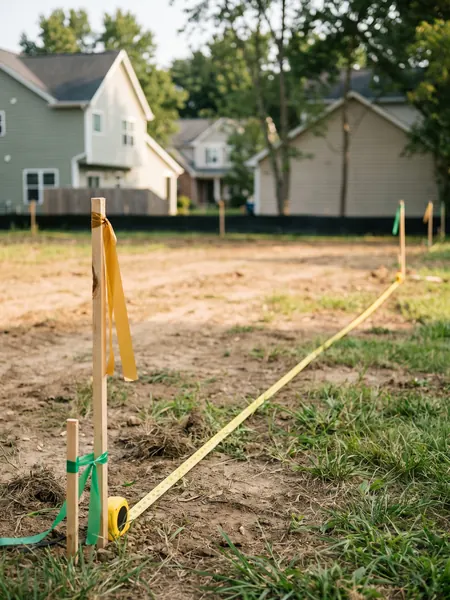
Setbacks are the minimum distances from the property lines to a building, and easements reserve strips for utilities or access. Together they shrink the part of the lot you can build on. Some codes also use a floor area ratio: total floor area divided by lot size.
Your local planning or zoning office has the exact rules. Check them before you plan an addition, a shed, a pool or a patio.
How to measure a lot
- Find the corner markers (survey pins or monuments) before you measure; the plat shows where they should be.
- Use a 100 ft tape or a measuring wheel, and measure horizontally, not along a slope.
- Write down each side and the diagonal in feet, then enter them in the calculator.
- Compare your lot size with the recorded one. A difference of more than a few percent usually means a missed corner.
Your lot size in acres
Enter the frontage and depth, or the four sides and a diagonal, and the lot size to acres calculator returns square feet, acres and lot coverage in one step. Check the result against the plat or deed, and download the PDF report to keep it with your plans.
Frequently asked questions
How do I convert lot size to acres?
Work out the lot size in square feet (frontage × depth for a rectangle), then divide by 43,560. A 75 × 140 ft lot is 10,500 sq ft, or 0.24 acres.
How do I calculate my lot size?
For a rectangular lot, multiply the frontage by the depth. For a lot with four unequal sides, measure all four sides plus one diagonal: the diagonal splits the lot into two triangles whose areas add up to the lot size.
How many square feet is a quarter-acre lot?
10,890 square feet. That could be roughly 75 × 145 ft or 100 × 109 ft; any outline that encloses 10,890 sq ft is a quarter acre.
What does 75 x 140 mean on a plat?
Frontage first, then depth: the lot is 75 feet wide along the street and 140 feet deep. That is 10,500 square feet, or 0.24 acres.
What is lot coverage?
Lot coverage is the share of the lot covered by buildings, and in some codes by patios and driveways too. A 2,200 sq ft footprint on a 10,500 sq ft lot is 21% coverage. Many zoning codes cap it.
Is lot size the same as acreage?
Same area, different unit. Residential lots are usually given in square feet and larger parcels in acres. 1 acre = 43,560 sq ft, so divide square feet by 43,560 for acres.
Where can I find the official size of my lot?
On the recorded plat for your subdivision, your deed, a boundary survey, or the county assessor's parcel record. Those figures govern for sales and permits, not tape measurements.
Sources