On this page
- Sod vs seed compared
- What each one costs
- What that means for your lawn size
- How long until you can use the lawn
- Watering and care in the first weeks
- Grass choice, shade and slopes
- Some grasses only come one way
- Soil prep is the same for both
- Common mistakes with each
- Options in between
- When each one makes sense
- Sod vs seed: making the call
Sod vs seed comes down to money versus time. Seed costs a fraction of sod, about $0.08 per square foot in materials against $0.69, and lets you pick any grass. Sod gives you a finished, rooted lawn in about 3 to 4 weeks and holds slopes right away.
Sod vs seed compared
Costs below are Fixr's averages for a 5,000 sq ft lawn. Establishment times come from the University of Maryland Extension.
| Seed | Sod | |
|---|---|---|
| Materials, per sq ft | $0.08 | $0.69 |
| Installed, per sq ft | $0.24 | $1.29 |
| Time until the grass roots | Germination, then weeks of growth | About 3 to 4 weeks |
| Watering at the start | Light and frequent, several weeks | Daily for the first two weeks |
| Grass choice | Any variety or blend | What local farms grow |
| Weeds at the start | Weeds compete with seedlings | Few, dense turf shades them out |
| Slopes | Seed can wash away | Holds soil right away |
| Best season | The right window for your grass | Most of the growing season |
What each one costs
Seed is dramatically cheaper. Fixr's average for seed materials is about $0.08 per square foot, against $0.69 for sod: close to nine times as much. For a 5,000 sq ft lawn, Fixr puts sod materials at $1,250 to $4,250.
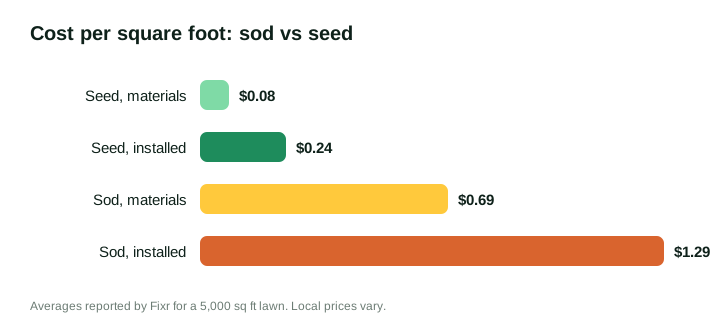
Labor widens the gap. Hiring it out, Fixr's installed averages are $0.24 per square foot for seed and $1.29 for sod. On a big yard, that difference pays for a lot of watering.
Sod also has costs people forget. It's heavy, it has to be laid the day it arrives, and you pay for the waste from cuts around beds and trees.
What that means for your lawn size
Multiply Fixr's per-square-foot averages by your lawn's area to get a rough budget. These are averages, so treat them as a starting point for quotes.
| Lawn | Seed, materials | Seed, installed | Sod, materials | Sod, installed |
|---|---|---|---|---|
| 1,000 sq ft | $80 | $240 | $690 | $1,290 |
| 2,500 sq ft | $200 | $600 | $1,725 | $3,225 |
| 5,000 sq ft | $400 | $1,200 | $3,450 | $6,450 |
| 10,000 sq ft | $800 | $2,400 | $6,900 | $12,900 |
The gap grows with the lawn. On 10,000 square feet, doing it yourself with seed costs about as much as a single pallet or two of sod.
How long until you can use the lawn
Sod looks finished the day it goes down, but it isn't ready for traffic. The University of Maryland Extension says sod establishes in typically 3 to 4 weeks, because only root growth is needed.
Seed has to germinate first, then grow into turf. Kentucky bluegrass is among the slowest; ryegrass among the quickest. A seeded lawn takes a full season to thicken, and Fixr notes it can take up to two years to match sod's density.
Seeding? Timing matters more than anything. See the best months for your grass type.
Read: when to plant grass seedWatering and care in the first weeks
Both need water, just in different patterns. The University of Maryland Extension suggests about a quarter inch of water per session for new lawns, with seedlings sometimes needing it several times a day for weeks.
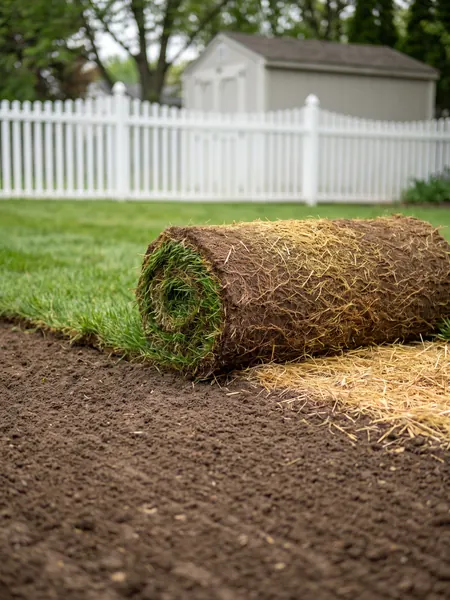
Sod wants a deep soak right after laying and daily watering for about two weeks, then less as roots grip the soil. Pennington stresses laying sod as soon as possible after harvest, ideally within 24 hours of cutting.
Seeded lawns are fussier. The top layer of soil must never dry out until the grass is up, which is hard in hot, windy weather and on slopes.
Grass choice, shade and slopes
Seed gives you the widest choice. You can pick a shade-tolerant fine fescue, a drought-hardy tall fescue or a blend matched to your yard. Sod farms grow what sells locally, which may not suit a shady corner.
Slopes flip the advice. Seed and mulch wash downhill in the first heavy rain, while sod holds the soil immediately. Many yards use both: sod on the bank, seed on the flat.
Going with sod?
Enter your lawn size to see how many pallets to order, with waste for the cuts built in.
Use the sod calculatorSome grasses only come one way
Your grass choice can make the decision for you. UC IPM notes that many warm-season species must be established by a method other than seed, such as sod, sprigs or plugs.
St. Augustine grass is the best-known example: it's sold as sod or plugs rather than seed. Bermudagrass, zoysia and buffalograss do come as seed, though many hybrid bermudagrass and zoysia lawns are still planted as sod.
Cool-season lawns are the opposite. Tall fescue, Kentucky bluegrass, perennial ryegrass and fine fescues all grow well from seed, and seed lets you blend them for sun, shade and wear.
Penn State Extension publishes seeding rates for each, from 2 to 3 lb per 1,000 sq ft for Kentucky bluegrass to 6 to 8 lb for turf-type tall fescue.
Soil prep is the same for both
Neither sod nor seed can fix bad soil. The University of Maryland Extension recommends starting with a soil test, then correcting pH and nutrients before you plant.
- Clear the site. Kill or strip old grass and weeds.
- Grade it. Slope the soil away from the house and fill low spots so water doesn't pool.
- Loosen and amend. Work in compost where the soil is compacted or poor.
- Feed it. Maryland Extension notes that a starter fertilizer containing phosphorus suits new lawns.
- Firm and rake. A smooth, slightly firm surface helps seed make contact and sod roots grip.
For sod, grade the soil slightly below walks and edges so the finished lawn sits flush. Seed goes on the surface and gets lightly raked in.
Common mistakes with each
With sod: letting pallets sit in the sun, leaving gaps between pieces, and under-watering the edges, which dry out first. Lay pieces in a staggered, brick-like pattern and push the seams tight.
With seed: sowing in the wrong season, spreading too much, and letting the surface dry out. Extra seed doesn't help: crowded seedlings compete for light and water. Stick to the rate for your grass.
With both: applying crabgrass preventer. The University of Maryland Extension notes that pre-emergent herbicides prevent seed germination. Walking on the new lawn too soon is the other shared mistake.
Options in between
You don't have to choose one for the whole yard.
Overseeding thickens a thin lawn by sowing into the existing grass, at the overseeding rate printed on the seed bag. It's the cheapest fix when the lawn is patchy rather than dead.
Sod strips plus seed works well where a yard has a slope or a front-yard showpiece: sod the parts that need to look finished or hold soil, seed the rest.
Hydroseeding sprays seed, mulch and water together. It's a contractor service, and the mulch in the mix helps hold the seed on slopes.
When each one makes sense
Our verdict
- Choose sod for slopes, small front yards, high-visibility areas, or when you need a usable lawn in weeks.
- Choose seed for large lawns, tight budgets, shady yards that need a special mix, and when you can seed in the right season.
- Do both when a yard has a slope or a showpiece strip: sod there, seed the rest.
Sod vs seed: making the call
Price and patience decide most yards. If a few hundred dollars and one season of watering don't bother you, seed gives you more grass for the money. If the lawn needs to look finished and hold a slope next month, sod is worth it.
Either way, prepare the soil well. That, more than sod vs seed, decides how the lawn looks in three years.
Sources