Which of our lawn calculators do you need?
A lawn project is a short chain of decisions: measure, prepare the soil, plant, feed. Each step has its own calculator, so pick the one that matches the job:
- Measuring the lawn first: the square footage calculator, which adds rectangles, circles and triangles.
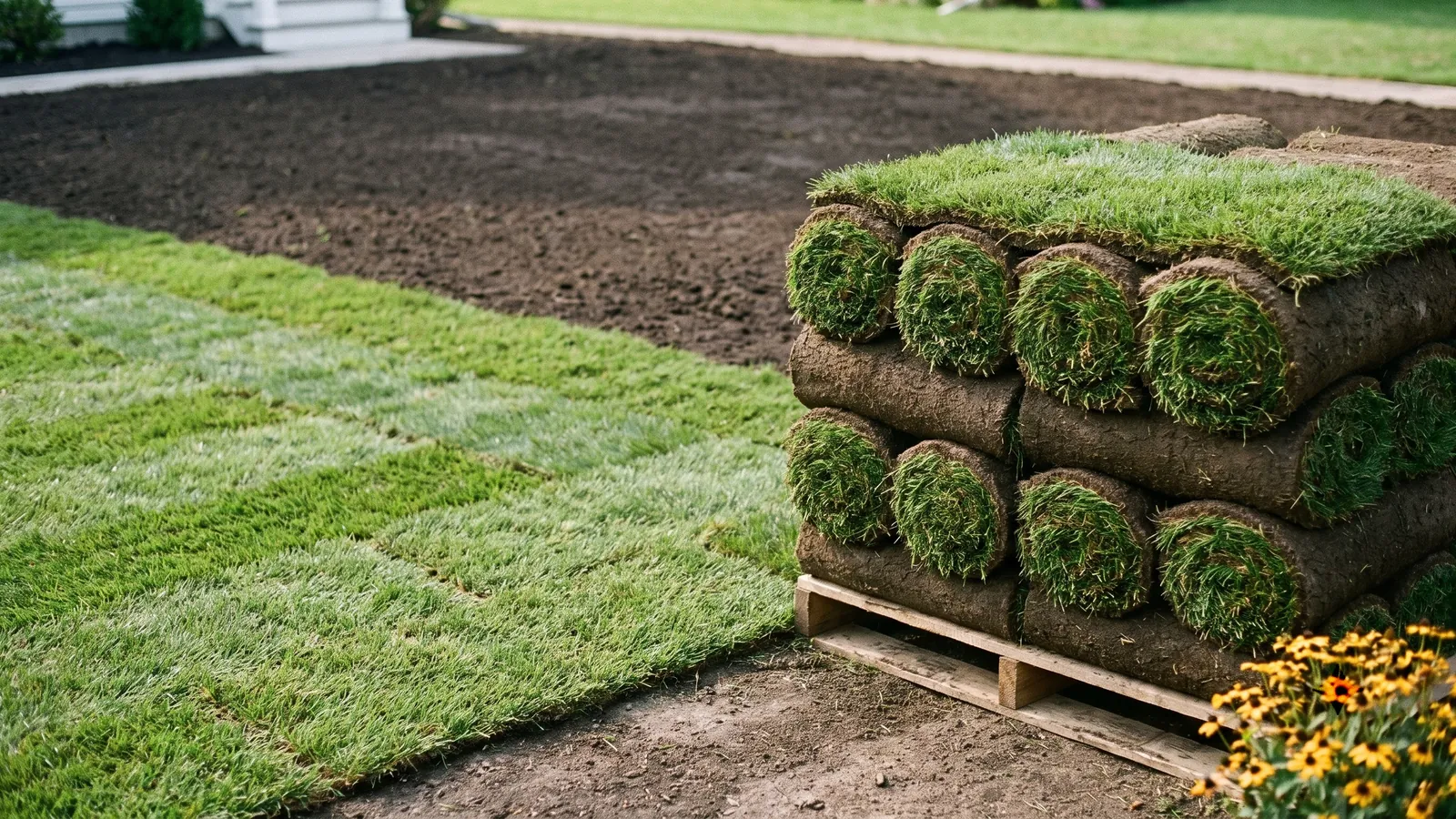
- Laying a lawn in a day: the sod calculator, with pallets, rolls and slabs.
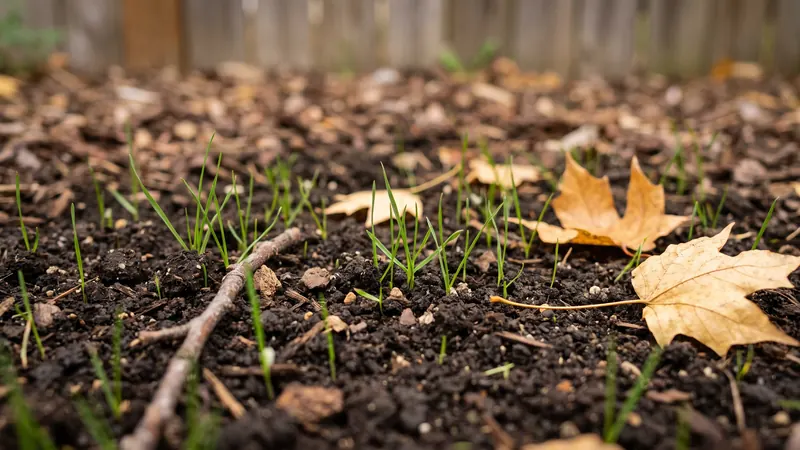
- Growing a lawn from seed or overseeding: the grass seed calculator, with pounds by grass type.
- Feeding an existing lawn: the lawn fertilizer calculator, which turns the N-P-K on the bag into pounds per 1,000 sq ft.
- Leveling or building up the soil: the topsoil calculator, and the compost calculator for top-dressing.
How lawn calculators work
Every lawn calculator starts from the square footage of the lawn and multiplies it by a rate: pallets for sod, pounds per 1,000 sq ft for seed and for nitrogen. Only the rate changes from one calculator to the next.
Worked example: a new 5,000 sq ft lawn
With 10% waste, sod needs 5,500 sq ft, which is 13 pallets at a coverage of 450 sq ft each. Seed for turf-type tall fescue at 7 lb per 1,000 sq ft is 35 lb. A first fertilizer feeding at 1 lb of nitrogen per 1,000 sq ft is 5 lb of nitrogen, or about 21 lb of 24-0-6 product.
How to measure your lawn in square feet
Split the yard into rectangles, find the area of each and add them. Riverview Turfworks gives an example: a 30 × 15 ft front yard (450 sq ft), a 3 × 10 ft side yard (30 sq ft) and a 30 × 30 ft backyard (900 sq ft) make 1,380 sq ft. Take out the house, drive and beds, which do not need grass.
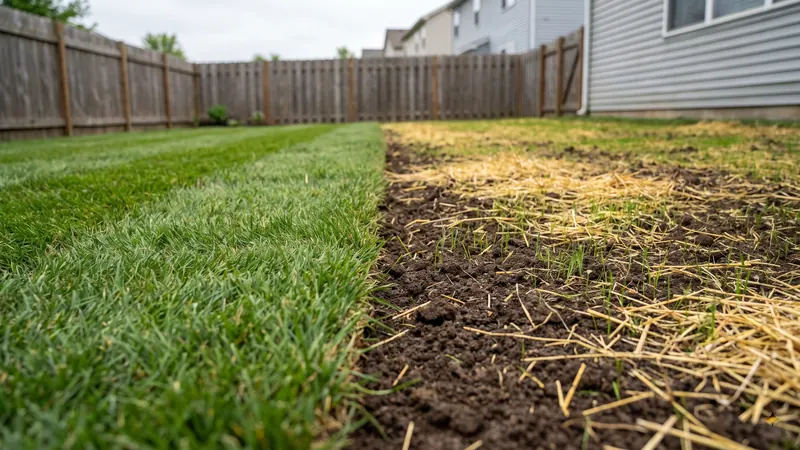
Sod vs seed compared
Costs are Fixr's averages. The sod timing comes from the University of Maryland Extension, which says sod roots are typically established in 2 to 3 weeks.
| Seed | Sod | |
|---|---|---|
| Materials, per sq ft | $0.08 | $0.69 |
| Installed, per sq ft | $0.24 | $1.29 |
| For 5,000 sq ft, materials | $400 | $3,450 |
| Time to a rooted lawn | Germination, then weeks of growth | 2–3 weeks to root |
| Grass choice | Any variety or blend | What local farms grow |
| Slopes | Seed can wash away | Holds the soil at once |
A professional installation costs $0.24 per sq ft for seed and $1.29 for sod in Fixr's averages. Seed costs a fraction of sod, and sod gives a finished lawn in a day. Our guide on sod vs seed compares the two for slopes, shade and budget.
Grass seed rates by type
The seeding rate depends on the grass. New-lawn rates in pounds per 1,000 sq ft, from Penn State Extension for cool-season grasses and the University of Maryland Extension for bermudagrass and zoysia. The grass seed calculator also shows UC IPM rates, and halves the rate for overseeding.
| Grass | Season | Pounds per 1,000 sq ft |
|---|---|---|
| Turf-type tall fescue | Cool | 6–8 |
| Kentucky bluegrass | Cool | 2–3 |
| Perennial ryegrass | Cool | 4–5 |
| Fine fescue | Cool | 4–5 |
| Bermudagrass (seeded) | Warm | 1 |
| Zoysia | Warm | 1 |
When to sow matters as much as the rate. The University of Maryland Extension puts the best window for cool-season grasses in mid-August to mid-October. See when to plant grass seed for warm-season grasses and soil temperatures.
Fertilizing schedule basics
Illinois Extension suggests about 3 lb of nitrogen per 1,000 sq ft per growing season for most cool-season lawns in full sun, and 1 lb of nitrogen per application. Do not exceed 1 lb of quick-release nitrogen at once. The number of feedings depends on how dense you want the lawn.
| Lawn | Feedings | When |
|---|---|---|
| Low density | 1 | Late summer to early fall |
| Low to moderate | 2 | Spring, late summer to early fall |
| Moderate to high | 3 | Spring, late summer to early fall, late season |
| High density | 4 | Spring, early summer if irrigated, late summer to early fall, late season |
In central Illinois that is early to mid-May, August 15 to September 15, and November. The lawn fertilizer calculator turns any bag's N-P-K into pounds to spread.
Watering a lawn
Illinois Extension says cool-season lawns need about 1 to 1.5 inches of water a week to stay green and growing. Water infrequently but thoroughly so the moisture reaches the roots, and water early in the day when the lawn is wet with dew. Coffee cans on the lawn show how much a sprinkler delivers.
It is also fine not to water. Cool-season grass can go dormant in a hot, dry summer. Avoid breaking dormancy again and again by letting the lawn brown and then rewatering it.
Prepare the soil before you plant
The University of Maryland Extension starts with a soil test. Then clear the old grass, grade the soil away from the house and rake it smooth. For sod it suggests spreading 1 to 2 inches of compost on the surface when you amend the soil. Use the topsoil calculator for leveling and the compost calculator for the amendment.
Lawn cost with your prices
Prices vary by region and by grower, so the lawn calculators never guess them. Enter the price per pallet of sod, per bag of seed and fertilizer, or per pound, and each tool adds up the materials. Plan for delivery, soil prep, a garden center trip and rental of a spreader or sod cutter for the whole project.
Common lawn mistakes
- Ordering exactly the lawn area. Sod needs 5 to 20% extra for cuts around curves and beds.
- One seed rate for every grass. Tall fescue and Kentucky bluegrass differ by a factor of three.
- Seeding at the wrong time. Wait for the window for your grass type.
- Feeding too much at once. Stay at or below 1 lb of quick-release nitrogen per application.
- Skipping the soil prep. Neither sod nor seed can fix bad soil.
Frequently asked questions
Are the lawn calculators free?
Yes. Every Terrainity lawn calculator is free, works on a phone, needs no account, and lets you download the estimate as a PDF report.
How much grass seed do I need per 1,000 square feet?
It depends on the grass. Penn State Extension gives 2 to 3 lb for Kentucky bluegrass, 4 to 5 lb for perennial ryegrass and 6 to 8 lb for turf-type tall fescue. Use the grass seed calculator to pick your grass.
How many pallets of sod do I need for 5,000 square feet?
With 10% waste you need 5,500 sq ft of sod. At 450 sq ft per pallet that is 13 pallets. Pallets run 450 to 500 sq ft depending on the grower, so check yours.
Is sod or seed cheaper?
Seed. Fixr's averages are about $0.08 per square foot for seed materials against $0.69 for sod. Sod gives a finished lawn quickly and holds slopes right away.
How often should I fertilize my lawn?
Illinois Extension suggests one to four feedings a year for cool-season lawns, depending on the density you want, at 1 lb of nitrogen per 1,000 sq ft each time and about 3 lb a year in full sun.
How accurate are the lawn calculators?
The math is exact for the area and rates you enter. The area is the part that varies, so measure the lawn carefully, take out beds and paving, and check the rate and coverage on your label or with your grower.
How much water does a lawn need?
Illinois Extension says cool-season lawns need about 1 to 1.5 inches of water a week to stay green. Water deeply and infrequently, early in the day.
Measure the lawn once, pick the one of our lawn calculators for your job, and download the PDF report with your pallets, pounds and bags before you order.