On this page
- How much sod do I need?
- How to use the sod calculator
- Sod roll, slab and pallet sizes
- Sod pallets needed by lawn size
- How to measure an irregular lawn
- How much extra sod to order
- How much does sod cost?
- How heavy is a pallet of sod?
- Grass types sold as sod
- Prepare the soil before the sod arrives
- How to lay sod
- Common sod mistakes
- Before you order sod
- Frequently asked questions
How much sod do I need?
Start with length × width = square feet, then add a waste allowance for the cuts around curves, beds and trees. A 40 × 25 ft lawn with 10% waste means ordering for 1,100 sq ft, just under 3 pallets.
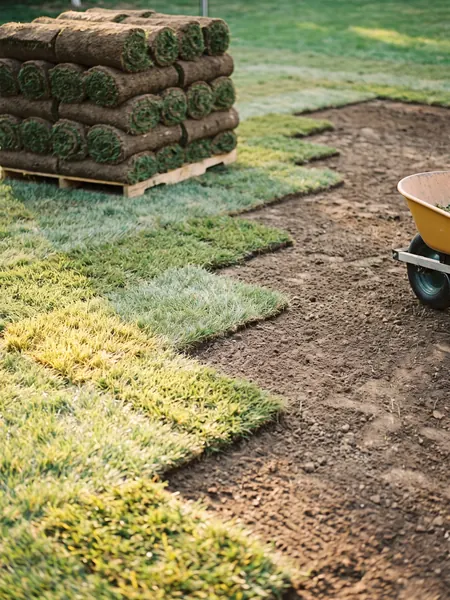
The total sod needed is the lawn area plus the waste. Sod comes by the pallet, usually 450 to 500 sq ft, and growers don't sell partial pallets, so the sod calculator rounds up.
The same lawn is 1,000 sq ft, so 10% waste makes 1,100 sq ft. Divided by a 450 sq ft pallet that is 2.4, which rounds up to 3 pallets.
Price per square foot, weeks to a usable lawn, and who should pick which.
Read the guideThe seeding windows for cool-season and warm-season grass, and why they work.
Read the guideHow to use the sod calculator
The sod calculator turns your lawn size into pallets, rolls and slabs of sod. The "How we calculated this" panel shows each step, and the PDF report keeps them for your sod supplier.
Step 1: Measure the lawn
Type the length and width of the area in feet, or the square feet if you know them. For an irregular lawn, split it into rectangles and add them up in the square footage calculator.
Step 2: Choose a waste allowance
Pick 5 to 10% for a simple rectangle and 15 to 20% when the lawn has curves, beds or trees.
Step 3: Enter the pallet size and price
Use the square feet per pallet and the price from your grower. The calculator shows the total number of pallets, the equivalent rolls and slabs, and the cost.
Sod roll, slab and pallet sizes
Sod comes in pre-cut pieces that are rolled or stacked. The size depends on the machine the grower used to harvest it, so ask for the exact coverage.
| Piece | Size | Per 450 sq ft pallet |
|---|---|---|
| Roll (small) | 10 sq ft | 45 rolls |
| Slab, 16 × 24 in | 2.67 sq ft | about 169 slabs |
| Large slab | up to 4 ft wide, 3½–6 ft long | varies by grower |
| Pallet | 450–500 sq ft | 1 pallet |
Inch Calculator gives these sizes: rolls and slabs from 16 to 24 inches wide, up to 4 feet for large slabs, and 3½ to 6 feet long. If your piece is a different size, multiply length by width in inches and divide by 144 to get square feet, then type that coverage into the sod calculator.
Sod pallets needed by lawn size
Based on a 450 sq ft pallet.
| Lawn size (sq ft) | 5% waste | 10% waste | 15% waste | 20% waste |
|---|---|---|---|---|
| 500 | 2 pallets | 2 pallets | 2 pallets | 2 pallets |
| 1,000 | 3 pallets | 3 pallets | 3 pallets | 3 pallets |
| 2,000 | 5 pallets | 5 pallets | 6 pallets | 6 pallets |
| 5,000 | 12 pallets | 13 pallets | 13 pallets | 14 pallets |
| 10,000 | 24 pallets | 25 pallets | 26 pallets | 27 pallets |
Sod has a shelf life
Sod is highly perishable. Lay it the day it arrives in warm weather: it heats up on the pallet. If rolls must wait a couple of days, unstack them and lay them flat in cool shade.
How to measure an irregular lawn
Split the yard into rectangles, find the area of each and add them. Riverview Turfworks gives an example: a 30 × 15 ft front yard (450 sq ft), a 3 × 10 ft side yard (30 sq ft) and a 30 × 30 ft backyard (900 sq ft) make 1,380 sq ft. At 2.67 sq ft per piece that is 517 pieces.
For a triangle, multiply base by height and divide by 2. For a circle, multiply π by the radius squared. Then add 15 to 20% for the cuts, or pick the waste in the sod calculator and let it do the rounding.
How much extra sod to order
Extra sod covers measuring errors, cuts at the edges and a few bad pieces on the pallet. Riverview Turfworks says 5% more is usually plenty. A lawn with curves, beds and trees to cut around needs more, so our default is 15 to 20% for those. You can set any percentage in the sod calculator.
How much does sod cost?
Enter the price per pallet in the sod calculator. Cost is the number of pallets times the price, plus delivery. At a price of $150 per pallet, our default, 3 pallets for a 1,000 sq ft lawn cost $450, or $0.45 per square foot of lawn.
Inch Calculator says very small areas can be bought by the roll, but above 400 sq ft consider buying by the pallet. The supplier usually delivers for a small fee.
How heavy is a pallet of sod?
One pallet weighs 1,500 to 3,000 lb depending on moisture, according to Inch Calculator. That is more than many pickups can safely carry, so plan delivery or a trailer rated for the load.
Grass types sold as sod
Cool-season sod such as Kentucky bluegrass (Poa pratensis) and tall fescue suits northern lawns. Warm-season sod such as bermudagrass, zoysia and St. Augustine grass suits the South. The University of Maryland Extension says sod can be laid any time the ground is above freezing and daytime temperatures are below 90°F.
Prepare the soil before the sod arrives
Remove old grass and weeds, grade the soil away from the house and rake it smooth. Get a soil test to see whether the soil needs lime or nutrients. The University of Maryland Extension suggests spreading 1 to 2 inches of compost on the soil surface when you amend it.
Before it arrives
Grade and rake the soil smooth, and moisten it the day before. Use the compost calculator for any amendment.
The first weeks
Water regularly for the first 2 to 3 weeks, daily if needed. Mow once the roots hold.
How to lay sod
Lay each strip up against its neighbor without overlapping, and tamp the edges down for good soil contact. Stagger the pieces from one row to the next like brickwork to hide the seams. Then use a lawn roller to push the pieces lightly onto the soil.
The University of Maryland Extension says to water sod regularly for the first 2 to 3 weeks after laying, and that roots are typically established in 2 to 3 weeks. Check by gently lifting a corner and looking for white young roots.
Common sod mistakes
- Ordering exactly the lawn area. Add 5 to 20% for waste and cuts.
- Letting sod sit on the pallet. It is perishable. Lay it the day it arrives, or store it flat in shade.
- Skipping soil preparation. Sod needs smooth, loosened soil to root.
- Underwatering. The first 2 to 3 weeks decide whether it roots.
Before you order sod
Measure the lawn, choose a waste allowance, and let the sod calculator turn it into pallets, rolls and slabs. Confirm the coverage per pallet with your grower, plan delivery and a laying day, and download the PDF report for your sod supplier.
Frequently asked questions
How much sod is on a pallet?
A pallet usually covers 450 to 500 square feet, according to Inch Calculator. It varies by grower and grass type, so confirm before ordering.
How much extra sod should I order?
Riverview Turfworks says 5% more is usually plenty for a simple lawn. Our default is 10%, and 15 to 20% for lawns with curves, beds and trees to cut around.
How long does sod take to root?
The University of Maryland Extension says sod roots are typically established in 2 to 3 weeks. Lift a corner and look for white young roots.
How many rolls of sod are on a pallet?
With small 10 sq ft rolls, a 450 sq ft pallet holds 45 rolls. Check your grower's spec sheet, since roll sizes differ.
How accurate is the sod calculator?
It gives the exact square footage for the length and width you enter, plus the waste you choose, rounded up to whole pallets. The measurements decide the accuracy, so measure twice and split odd shapes into rectangles.
How much does a pallet of sod weigh?
Inch Calculator says one pallet weighs between 1,500 and 3,000 lb, depending on moisture. Make sure a truck or trailer can carry that, or pay for delivery.
How many pieces of sod are in 1,000 square feet?
Using 16 × 24 inch pieces of 2.67 sq ft each, 1,000 sq ft takes about 375 pieces before waste, and about 412 with 10% waste.
Sources