On this page
- How much fertilizer do I need?
- How to use the lawn fertilizer calculator
- How to read the N-P-K label
- Product per 1,000 sq ft and per acre by nitrogen %
- Worked example for a 5,000 sq ft lawn
- How much nitrogen does a lawn need?
- When to fertilize a lawn
- Quick-release vs slow-release fertilizer
- Organic, granular and liquid fertilizer
- Fertilizer per acre
- Fertilizer cost per pound of nitrogen
- Setting your spreader
- Common lawn fertilizer mistakes
- Before you buy fertilizer
- Frequently asked questions
How much fertilizer do I need?
Lawn fertilizer rates are set in pounds of nitrogen per 1,000 sq ft, not pounds of product. The bag's first number tells you how much nitrogen is inside. A 5,000 sq ft lawn fed 1 lb of nitrogen from a 24-0-6 bag needs about 21 lb of product.
Penn State's example: to apply 1 lb of nitrogen with a 26-5-10 fertilizer, spread 1 ÷ 0.26 = 3.8 lb of product per 1,000 sq ft. The higher the nitrogen percentage, the less product you spread.
Iowa State Extension gives the same method: divide the nitrogen rate you want by the nitrogen in the analysis. At 0.75 lb on a 20-5-10 fertilizer, that is 0.75 ÷ 0.20 = 3.75 lb.
How to use the lawn fertilizer calculator
The tool turns your N-P-K numbers and lawn size into pounds of product, bags and nutrients applied. The "How we calculated this" panel shows each step, and the PDF report keeps them.
Step 1: Enter the lawn area
Type the length and width in feet, or the square feet if you know them. Measure only the turf, and subtract beds and drives. The square footage calculator handles odd shapes.
Step 2: Enter the numbers on the bag
Type the nitrogen, phosphate and potash percentages from the fertilizer bag. They are the N-P-K grade, such as 24-0-6.
Step 3: Pick the nitrogen rate
Choose 0.5, 0.75 or 1 lb of nitrogen per 1,000 sq ft. Follow your bag if it says less.
Step 4: Add the bag weight and price
The result shows the bags to buy, the cost and the cost per pound of nitrogen.
How to read the N-P-K label
The fertilizer label lists three numbers. Illinois Extension says percent nitrogen by weight is always first, followed by phosphorus and potassium. They are expressed as nitrogen (N), phosphate (P₂O₅) and potash (K₂O).
To see what you apply, multiply the product by each percentage. Penn State's example: 3.8 lb of product per 1,000 sq ft at 5 percent phosphate delivers 0.19 lb of phosphate per 1,000 sq ft.
Product per 1,000 sq ft and per acre by nitrogen %
| Nitrogen on the bag | For 1 lb N | For 0.5 lb N | Per acre at 1 lb N |
|---|---|---|---|
| 10% | 10.0 lb | 5.0 lb | 436 lb |
| 16% | 6.2 lb | 3.1 lb | 272 lb |
| 20% | 5.0 lb | 2.5 lb | 218 lb |
| 24% | 4.2 lb | 2.1 lb | 182 lb |
| 29% | 3.4 lb | 1.7 lb | 150 lb |
| 32% | 3.1 lb | 1.6 lb | 136 lb |
Worked example for a 5,000 sq ft lawn
You want 1 lb of nitrogen per 1,000 sq ft and the bag says 24-0-6. Product per 1,000 sq ft is 1 ÷ 0.24 = 4.17 lb. The lawn is 5 thousand sq ft, so you need 4.17 × 5 = 20.8 lb. With 15 lb bags, buy 2.
That applies 5 lb of nitrogen, 0 lb of phosphate and 1.25 lb of potash across the lawn.
Test before you feed
A soil test shows whether you need phosphorus or potassium at all. Many lawns only need nitrogen, and extra phosphorus can wash into streams.
Price per square foot, weeks to a usable lawn, and who should pick which.
Read the guideThe seeding windows for cool-season and warm-season grass, and why they work.
Read the guideHow much nitrogen does a lawn need?
Illinois Extension suggests one pound of nitrogen per 1,000 sq ft for each application, and about three pounds per 1,000 sq ft a year for a sunny lawn, with half that for shade. Iowa State Extension gives rates of 0.5 to 1 lb of actual nitrogen per 1,000 sq ft.
When to fertilize a lawn
For cool-season lawns, Illinois Extension lists early to mid-May, August 15 to September 15, and late October to early November in central Illinois. Your dates shift with your climate and your grass type, so check your state extension service for the application rate and season that fit your lawn.
Quick-release vs slow-release fertilizer
Quick-release nitrogen feeds the lawn fast and is easy to overapply. Slow-release or controlled-release nitrogen, such as sulfur-coated urea and water-insoluble nitrogen, feeds over weeks. Many labels state the percentage of slow-release nitrogen. The calculator uses total nitrogen either way.
Organic, granular and liquid fertilizer
The math is the same for organic fertilizer, but organic products carry a lower nitrogen percentage, so you spread more product for the same nitrogen.
Washington State University Extension offers a calculator for both organic and conventional fertilizer. For liquid products, use the nitrogen percentage on the label and follow its mixing directions.
Fertilizer per acre
For a large property, multiply the product per 1,000 sq ft by 43.56, because an acre is 43,560 sq ft. Penn State's example: 4.7 lb of 16-8-8 per 1,000 sq ft is about 205 lb per acre. The result panel shows the per-acre figure.
Fertilizer cost per pound of nitrogen
Bag price alone misleads, because bags differ in nitrogen content. Divide the bag price by the pounds of nitrogen it holds. A $35, 15 lb bag of 24-0-6 holds 3.6 lb of nitrogen, so nitrogen costs about $9.72 per pound. That price is our example.
Setting your spreader
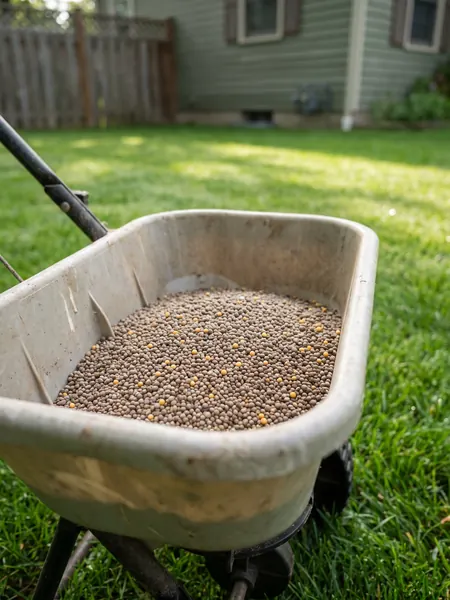
Most bags print spreader settings for common models. If yours isn't listed, weigh out the product for 1,000 sq ft, mark off that area, and adjust the setting until the spreader runs empty right at the end. Go in two directions at half the rate for even coverage.
Common lawn fertilizer mistakes
- Confusing product with nutrient. A 20 lb bag of 24-0-6 holds 4.8 lb of nitrogen, not 20.
- Applying too much at once. Too much quick-release nitrogen can burn the grass. Stick to the application rate on the label.
- Measuring the whole lot. Fertilize only the turf area.
- Fertilizing before heavy rain. It can wash off.
Before you buy fertilizer
Measure the turf, read the nitrogen on the bag, and let the lawn fertilizer calculator turn it into pounds of product and bags. Take a soil test, compare cost per pound of nitrogen, and download the PDF report for the garden center.
Frequently asked questions
How do I know how much fertilizer to put down?
Divide the pounds of nitrogen you want per 1,000 sq ft by the nitrogen percentage on the bag. For 1 lb of nitrogen from a 26-5-10 fertilizer: 1 ÷ 0.26 = 3.8 lb of product per 1,000 sq ft (Penn State Extension).
What do the three numbers on a fertilizer bag mean?
They are the N-P-K grade: the percentage by weight of nitrogen (N), phosphate (P₂O₅) and potash (K₂O). Nitrogen is always first. A 50 lb bag of 20-5-10 holds 10 lb of nitrogen.
How much nitrogen does a lawn need per year?
Illinois Extension suggests 1 lb of nitrogen per 1,000 sq ft for each application, and about 3 lb per 1,000 sq ft a year for a sunny lawn, with half that for shaded areas.
How much fertilizer do I need per acre?
Multiply the pounds per 1,000 sq ft by 43.56. Penn State's example: 4.7 lb of 16-8-8 per 1,000 sq ft is about 205 lb per acre.
Should I fertilize a new lawn differently?
New lawns usually get a starter fertilizer that contains phosphorus, according to the University of Maryland Extension. A soil test tells you whether your soil actually needs it.
How accurate is the lawn fertilizer calculator?
It gives the exact pounds of product for the nitrogen rate and bag grade you enter. Accuracy in the field depends on your lawn measurement and a calibrated spreader, so check the settings on the bag.
Do I need phosphorus on my lawn?
Often not. Iowa State Extension says many Iowa soils do not need extra phosphorus except at seeding, and Illinois Extension says its soils often have enough. A soil test shows your levels.
Sources