On this page
- How much mulch do I need?
- How to use the mulch calculator
- Mulch coverage by area and depth
- How many bags of mulch are in a cubic yard?
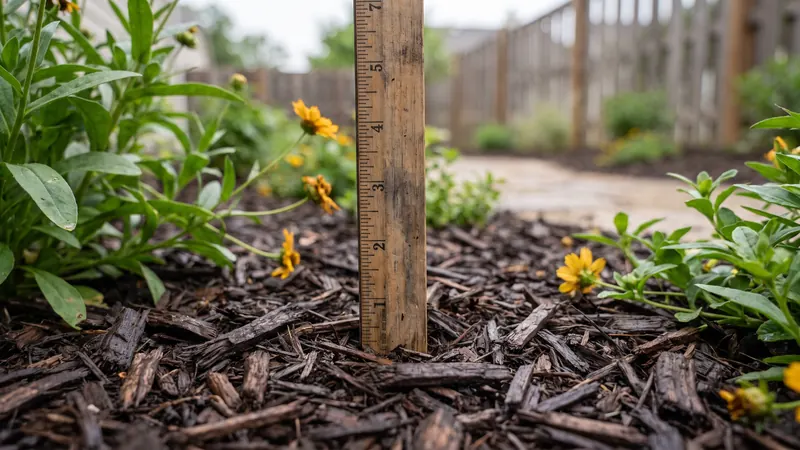
- How deep should mulch be?
- How to measure mulch for any bed shape
- Mulch around trees and shrubs: no volcanoes
- Adding mulch to an existing bed
- Types of mulch
- How much does a yard of mulch weigh?
- Bags vs. bulk mulch
- How much does mulch cost?
- Weed barrier and landscape fabric under mulch
- Benefits of mulch
- Common mulch mistakes
- Before you order mulch
- Frequently asked questions
How much mulch do I need?
Mulch is sold by volume, not by the bag, which is why "how many bags" is hard to answer without doing the math first.
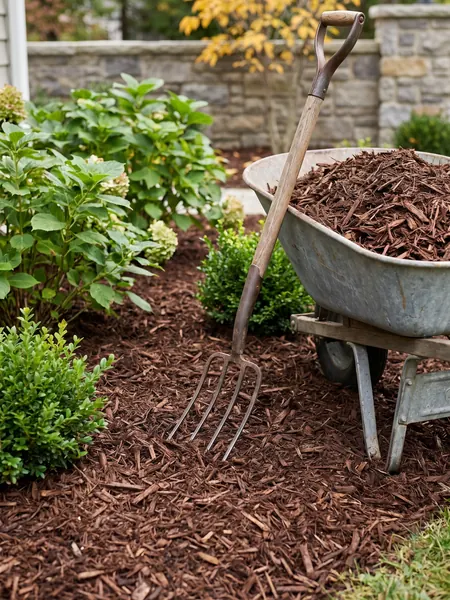
Multiply the length and width of your bed to get square feet, multiply by the depth (in feet), and you have cubic feet. Divide by 27 to get cubic yards, the unit bulk mulch is priced and delivered in.
A 10×10 ft bed (100 sq ft) at 3 inches needs 100 × 0.25 = 25 cubic feet: about 0.93 cubic yards, or 13 bags of 2 cubic feet.
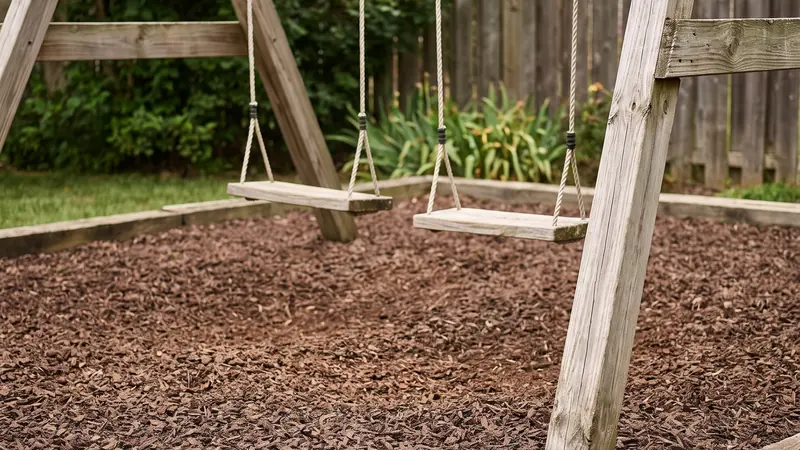
Flower beds, tree rings, paths and playgrounds all need different depths.
Read the guideCost, heat, weeds and upkeep compared, with a clear verdict for each yard.
Read the guideHow to use the mulch calculator
The mulch calculator turns a bed size and a depth into cubic yards, cubic feet and bags. The "How we calculated this" panel shows every step, and the PDF report keeps them for your supplier.
Step 1: Measure the bed
Type the length and width in feet, or the square feet if you know them. For a curved bed, split it into rectangles, circles and triangles and add them in the square footage calculator.
Step 2: Pick the depth in the mulch calculator
Choose 2, 3, 4 or 6 inches. If the bed already has mulch, type its depth under "Mulch already in the bed" and it adds only the difference.
Step 3: Set the bag size, the extra and the prices
Pick 2 or 3 cubic feet to match your bag, add 10% extra if you want a safety margin, and type your bag price and bulk price per yard to compare the two ways to buy.
Mulch coverage by area and depth
Bag counts assume standard 2 cu ft bags, rounded up to whole bags.
| Bed size (sq ft) | 2 in deep | 3 in deep | 4 in deep | Cubic yards (3 in) |
|---|---|---|---|---|
| 50 | 5 bags | 7 bags | 9 bags | 0.46 yd³ |
| 100 | 9 bags | 13 bags | 17 bags | 0.93 yd³ |
| 200 | 17 bags | 25 bags | 34 bags | 1.85 yd³ |
| 500 | 42 bags | 63 bags | 84 bags | 4.63 yd³ |
| 1,000 | 84 bags | 125 bags | 167 bags | 9.26 yd³ |
Measure irregular beds in pieces
Curvy bed? Split it into rectangles, circles and triangles and add them up. The square footage calculator does the adding and sends the total back here.
How much does a cubic yard of mulch cover?
A cubic yard is 27 cubic feet, so it covers 324 square feet at 1 inch and half of that at each doubling of the depth. Inch Calculator gives the same figures: 162 square feet at 2 inches and 81 at 4 inches.
| Depth | One cubic yard covers | One 2 cu ft bag covers | One 3 cu ft bag covers |
|---|---|---|---|
| 1 in | 324 sq ft | 24 sq ft | 36 sq ft |
| 2 in | 162 sq ft | 12 sq ft | 18 sq ft |
| 3 in | 108 sq ft | 8 sq ft | 12 sq ft |
| 4 in | 81 sq ft | 6 sq ft | 9 sq ft |
| 6 in | 54 sq ft | 4 sq ft | 6 sq ft |
How many bags of mulch are in a cubic yard?
Most bags hold 2 cubic feet, and some hold 3, according to Inch Calculator. A yard is 27 cubic feet, so it takes 13.5 bags of 2 cubic feet or 9 bags of 3 cubic feet. You cannot buy half a bag, so round up.
| Mulch you need | 2 cu ft bags | 3 cu ft bags |
|---|---|---|
| 1 yd³ | 14 bags | 9 bags |
| 2 yd³ | 27 bags | 18 bags |
| 5 yd³ | 68 bags | 45 bags |
| 10 yd³ | 135 bags | 90 bags |
How deep should mulch be?
Depth decides both the weed control and the order. Too little lets light through, and too much holds water against stems and roots. These are the depths the extension services give.
| Source | Mulch | Depth |
|---|---|---|
| Utah State University Extension | Organic mulch | 3–4 in |
| Utah State University Extension | Inorganic mulch (rock, gravel) | 2–3 in |
| Penn State Extension | Ornamental beds | 3–4 in |
| Penn State Extension | Around trees | 2–4 in, kept 3–4 in off the trunk |
| Inch Calculator | Fine mulch / coarse mulch | 1–2 in / 3–4 in |
Our guide on how deep mulch should be goes through beds, tree rings, paths and playgrounds one by one.
How to measure mulch for any bed shape
Every shape gets reduced to square feet first. The calculator takes length and width, so convert round and angled beds with these formulas.
| Shape | Area in square feet |
|---|---|
| Rectangle or square | Length × width |
| Circle | π × radius² (radius = diameter ÷ 2) |
| Triangle | ½ × base × height |
| Tree ring (ring around a trunk) | π × (outer radius² − inner radius²) |
Worked example: a mulch ring around a tree
A ring 6 ft across with a 1 ft clear circle around the trunk has an area of π × (3² − 0.5²) = 27.5 sq ft. At 3 inches that is 6.9 cubic feet, or 4 bags of 2 cubic feet.
Mulch around trees and shrubs: no volcanoes
Penn State Extension warns against "mulch volcanoes," where mulch is piled against the trunk. Keep it 3 to 4 inches away from the trunk base, and spread it out to the drip line. Utah State Extension adds that a few inches of mulch-free area around woody plants prevents root collar disease and rodent damage.
Adding mulch to an existing bed
If the bed already has mulch, you only need the difference between the depth you want and the depth that is there. A bed with 1 inch left that should be 3 inches deep needs 2 inches. Clemson Extension suggests replacing organic mulch every year or every other year.
Types of mulch
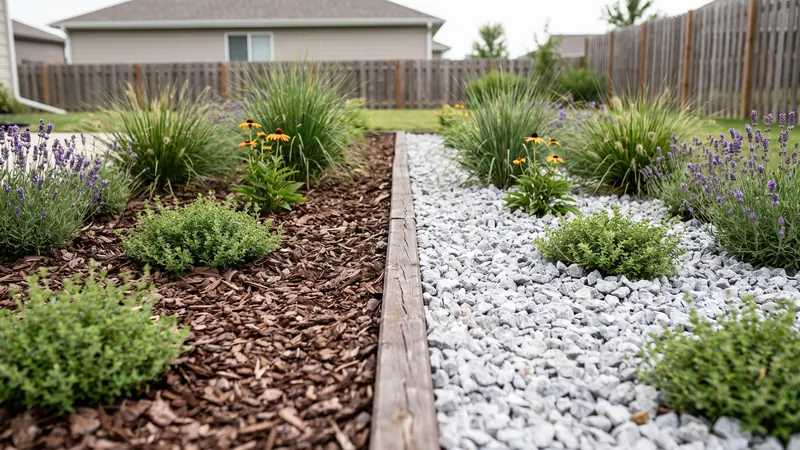
Mulches are either organic or inorganic. Utah State Extension says organic mulches such as wood chips, bark and pine needles improve soil structure and fertility as they break down, but need replenishing. Inorganic mulches such as rock, gravel, lava rock and recycled glass drain well and add no nutrients.
| Mulch | Type | Typical weight per cubic yard | Notes |
|---|---|---|---|
| Bark mulch | Organic | 506 lb (The Calculator Site) | Shredded or nuggets. Decomposes and feeds the soil. |
| Wood chips | Organic | 674 lb (The Calculator Site) | Coarse, with air gaps. Also sold as arborist chips. |
| Pine needles, straw, shredded leaves | Organic | light, varies | Penn State lists them among organic mulches. |
| Rock and gravel | Inorganic | well over a ton | Does not break down. See mulch vs rock. |
| Rubber mulch | Inorganic | about 2,410 lb | For playgrounds and beds. See the rubber mulch calculator. |
Dyed mulch uses carbon-based black dye or iron oxide red dye, says Penn State Extension. It also warns that recycled wood from before 2003 may contain CCA preservative, so buy mulch from a source that says what wood it uses.
How much does a yard of mulch weigh?
Inch Calculator says a cubic yard of mulch weighs 400 to 800 pounds depending on the material and its moisture, and that a 2 cubic foot bag weighs about 20 pounds and a 3 cubic foot bag about 30 pounds. Wet mulch is heavier, so a pickup load of 2 yards can top 1,000 pounds.
Bags vs. bulk mulch
Bagged mulch
Suits small beds. Fits in a car, easy to store, no delivery fee, but it costs more per cubic foot. Most bags are 2 cu ft, and some are 3.
Bulk mulch
Worth pricing once you pass a yard or two. Dumped on your driveway and cheaper per unit, but you need a wheelbarrow and most suppliers have a minimum order.
How much does mulch cost?
Type your own prices in the calculator. At our default prices of $4.25 a bag and $32 a cubic yard, the 100 sq ft bed at 3 inches costs about $55 in 13 bags or $30 in bulk, before delivery. Delivery fees and minimum orders can change that, so ask your supplier.
Weed barrier and landscape fabric under mulch
Mulch does the weed control by blocking light, so fabric is optional. Utah State Extension says the best weed barriers are landscape fabrics that allow air exchange and water infiltration, that plastic sheeting should be avoided, and that fabric barriers last about 5 years.
Benefits of mulch
- Moisture: Clemson Extension notes that organic mulch holds moisture in the soil.
- Temperature: it keeps soil cool in summer and warm in winter.
- Weeds: a deep enough layer blocks the light weed seeds need.
- Erosion: a layer of mulch protects bare soil from heavy rain.
- Soil: organic mulch feeds the soil as it breaks down.
Common mulch mistakes
- Piling it against the trunk. Keep mulch 3 to 4 inches off the bark.
- Going too deep. More than 4 inches can hold too much moisture against roots and stems.
- Forgetting the extra. Add about 10% and round the bags up.
- Not subtracting old mulch. A top-up needs only the missing depth.
Before you order mulch
Measure each bed, pick the depth for the plants in it, and let the mulch calculator turn it into cubic yards and bags. Compare the bag price with the bulk price, add about 10% extra, and download the PDF report to take to the garden center.
Frequently asked questions
How much mulch do I need?
Multiply the bed's length and width in feet for square feet, then multiply by the depth in inches divided by 12 for cubic feet, and divide by 27 for cubic yards. A 10 × 10 ft bed at 3 inches needs 25 cubic feet, or 0.93 cubic yards.
How deep should mulch be?
Utah State University Extension says to spread organic mulch 3 to 4 inches deep and inorganic mulch such as rock 2 to 3 inches deep. Inch Calculator suggests 1 to 2 inches for fine mulch and 3 to 4 inches for coarser material.
How many bags of mulch are in a cubic yard?
A cubic yard is 27 cubic feet, so it takes 13.5 bags of 2 cubic feet (Inch Calculator rounds up to 14) or 9 bags of 3 cubic feet.
How much does a bag of mulch cover?
A 2 cubic foot bag covers 8 square feet at 3 inches deep and 12 square feet at 2 inches. A 3 cubic foot bag covers 12 square feet at 3 inches. Check the cubic feet printed on your bag.
How much does a yard of mulch cover?
One cubic yard covers 108 square feet at 3 inches deep, 162 square feet at 2 inches and 81 square feet at 4 inches. Inch Calculator says a yard covers just over 100 square feet at 3 inches.
How much does a yard of mulch weigh?
Inch Calculator says a cubic yard of mulch weighs 400 to 800 pounds, depending on the material and its moisture. The Calculator Site lists bark mulch at 506 pounds and wood chips at 674 pounds per cubic yard.
Is it cheaper to buy mulch in bulk or in bags?
Inch Calculator says large quantities may be discounted in bulk, while bags are more convenient for small projects. Compare in the same unit: at our default prices, 13.5 bags cost about $57 per yard against $32 in bulk, before delivery.
How much extra mulch should I buy?
Inch Calculator recommends adding about 10% to the estimated volume, and rounding up rather than down when you are between bag counts. The calculator has a 10% option.
Do I need landscape fabric under mulch?
Not always. Utah State University Extension says that if you use a weed barrier, choose a landscape fabric that lets air and water through, and avoid plastic sheeting. Fabric barriers last about 5 years.
How accurate is the mulch calculator?
The math is exact for the measurements you enter. The real result depends on how level the bed is, how loosely the mulch is spread and the bag size on the label, so measure the bed twice and round up.
Sources
- Utah State University Extension: Water-Wise Landscaping, Mulch
- Penn State Extension: Mulch, A Survey of Available Options
- Clemson Cooperative Extension HGIC: Mulch or Rock, Which Do You Prefer?
- Inch Calculator: mulch bag sizes, overage, weight per yard and bag
- The Calculator Site: How Much Does a Cubic Yard Weigh?