On this page
- How much rubber mulch do I need?
- How to use the rubber mulch calculator
- Rubber mulch depth for playgrounds
- Playground surfacing: containment, drainage and upkeep
- Rubber mulch coverage by depth
- Rubber mulch for landscaping and garden beds
- Rubber mulch vs wood chips for play areas
- How much does rubber mulch weigh?
- What does rubber mulch cost?
- Common rubber mulch mistakes
- Before you order rubber mulch
- Frequently asked questions
How much rubber mulch do I need?
Area × depth ÷ 12 gives cubic feet; divide by the bag size on the label. For playgrounds, plan 6 inches, as the CPSC recommends for shredded rubber.
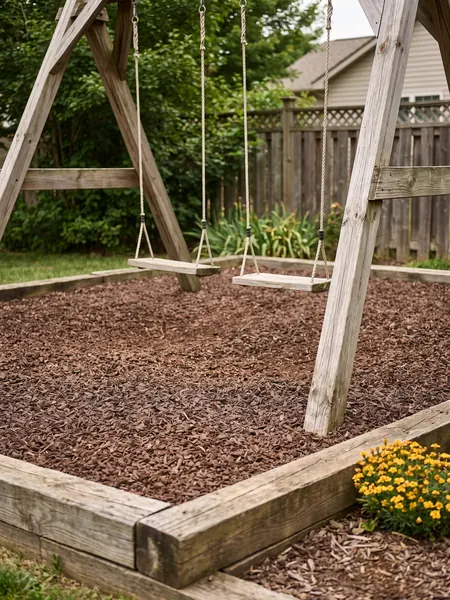
A 20 × 15 ft play area at 6 inches is 150 cu ft: 188 bags of 0.8 cu ft, or 5.6 cubic yards in bulk. At GravelShop's 2,410 lb per cubic yard, that is about 6.7 tons.
How to use the rubber mulch calculator
This tool turns an area and a depth into cubic yards and bags. The "How we calculated this" panel shows each step, and the PDF report lists them for your supplier.
Step 1: Enter the area to cover
Type the length and width in feet. For a ring around play equipment or an odd-shaped bed, find the total in the square footage calculator and enter it as square feet.
Step 2: Choose the depth in the rubber mulch calculator
Pick 6 inches for a playground, or 2 to 3 inches for a garden bed. Then set your bag size from the label and an allowance for displacement if the area has swings or slides.
Rubber mulch depth for playgrounds
The CPSC Public Playground Safety Handbook sets the minimum depth of each loose-fill material by the fall height it protects against. The depths assume the material has already compressed and is kept at that level.
| Loose-fill material | Minimum compressed depth | Protects to fall height |
|---|---|---|
| Shredded / recycled rubber | 6 in | 10 ft |
| Wood chips | 9 in | 10 ft |
| Wood mulch (non-CCA) | 9 in | 7 ft |
| Pea gravel | 9 in | 5 ft |
| Sand | 9 in | 4 ft |
The handbook says never to use less than 9 inches of loose fill except for shredded rubber, where 6 inches is recommended. Shallower layers are too easily displaced and compacted.
Compression: why wood needs 12 inches
The CPSC says loose fill compresses at least 25% over time. If a playground needs 9 inches of wood chips, the first fill should be 12 inches. Shredded rubber does not compress in the same manner, but the handbook warns that displacement can still happen.
Residential and commercial playgrounds
Suppliers separate home playgrounds from commercial ones. GroundSmart lists 4 to 5 inches for a residential playground and 5 to 6 inches for a commercial playground. Custom Park says 3 to 4 inches for residential use and a minimum of 6 inches for commercial. The CPSC recommends 6 inches of shredded rubber, so treat a lower depth as valid only for the fall height and product that the maker has tested to ASTM F1292.
Playground surfacing: containment, drainage and upkeep
Depth is only part of a safe surface. The CPSC handbook adds these points for loose fill:
- Contain it. The perimeter of the playground should have a way to hold the loose fill in.
- Drain it. Standing water reduces effectiveness and leads to compaction and decomposition.
- Maintain it. Areas under swings and slide exits lose material first, so check them often. Wear mats can reduce displacement.
- Mark the depth. Marking a fill line on equipment supports makes it easy to see when to top up.
- Add layers over a hard surface. Use a 3 to 6 inch base of gravel for drainage, then geotextile cloth, then the loose fill.
Use surfacing made for play
The CPSC recommends rubber mulch products that have been tested to ASTM F1292 for use under play equipment. Check the bag or ask the maker for the test data. The CPSC listing covers impact protection only, not chemical exposure or ingestion.
Rubber mulch coverage by depth
These figures are straight volume math. A cubic yard is 27 cubic feet, and a 0.8 cubic foot bag is a common retail size, so replace it with the size on your label.
| Depth | One cubic yard covers | One 0.8 cu ft bag covers |
|---|---|---|
| 2 in | 162 sq ft | 4.8 sq ft |
| 3 in | 108 sq ft | 3.2 sq ft |
| 4 in | 81 sq ft | 2.4 sq ft |
| 6 in | 54 sq ft | 1.6 sq ft |
Common play area sizes at 6 inches
| Play area | Area | Rubber mulch | Cubic yards | 0.8 cu ft bags |
|---|---|---|---|---|
| 10 × 10 ft | 100 sq ft | 50 cu ft | 1.85 yd³ | 63 bags |
| 12 × 16 ft | 192 sq ft | 96 cu ft | 3.56 yd³ | 120 bags |
| 20 × 15 ft | 300 sq ft | 150 cu ft | 5.56 yd³ | 188 bags |
| 30 × 20 ft | 600 sq ft | 300 cu ft | 11.11 yd³ | 375 bags |
Rubber mulch for landscaping and garden beds
In landscape beds, rubber mulch goes on thinner than under a swing set. GroundSmart suggests 1.5 to 2 inches for landscaping, and Custom Park says 1 to 2 inches is typically enough. Both list weed control and moisture retention as benefits.
Because rubber does not decompose, it never needs topping up the way wood does, but it also adds nothing to the soil. For beds where you want the soil to improve, use the mulch calculator for wood mulch instead.
Rubber mulch vs wood chips for play areas
On the CPSC table, wood chips need 9 inches to protect to 10 feet, where rubber needs 6. Wood mulch protects to 7 feet at 9 inches, and pea gravel to 5 feet. Wood must be topped up as it decomposes, and CCA-treated wood mulch should not be used.
How much does rubber mulch weigh?
GravelShop gives 2,410 lb per cubic yard for shredded rubber mulch, about 1.2 tons or 89 pounds per cubic foot. At that density, a 0.8 cubic foot bag weighs about 71 pounds. Suppliers differ by grind and moisture, so confirm the weight when you plan delivery.
What does rubber mulch cost?
Enter your supplier's bag price and bulk price per cubic yard in the calculator and it adds up each way of buying. Rubber mulch is usually sold by the bag, by the pallet or by the yard, so compare quotes in the same unit, and add delivery.
Common rubber mulch mistakes
- Going too thin under play equipment. The CPSC recommends 6 inches for shredded rubber.
- Skipping the border. Without containment the fill spreads into the lawn.
- Ignoring drainage. Standing water compacts the surface.
- Never checking the depth. Swings and slide exits displace the fill first.
Before you order rubber mulch
Measure the play area, choose a depth that matches your product's tested fall height, and let the rubber mulch calculator turn it into bags and cubic yards. Add an allowance for displacement under swings and slides, then download the PDF report for your supplier.
Covering garden beds with wood mulch instead? Use the mulch calculator.
Mulch calculatorFrequently asked questions
How deep should rubber mulch be on a playground?
The CPSC Public Playground Safety Handbook recommends 6 inches of shredded or recycled rubber, which protects to a fall height of 10 feet. Other loose-fill materials need at least 9 inches.
How much rubber mulch do I need for a playground?
Multiply the area in square feet by 0.5 ft (6 inches) for cubic feet, and divide by 27 for cubic yards. A 20 × 15 ft play area needs 150 cubic feet, or 5.6 cubic yards.
Does rubber mulch compress?
The CPSC says shredded rubber does not compress in the same manner as other loose fill, but it can still be displaced, so check the depth often. Wood chips and sand are assumed to compress at least 25%.
How much does a bag of rubber mulch cover?
It depends on the bag size printed on the label. A 0.8 cu ft bag covers 1.6 sq ft at 6 inches, 3.2 sq ft at 3 inches and 4.8 sq ft at 2 inches.
How much does rubber mulch weigh?
GravelShop lists shredded rubber mulch at 2,410 pounds per cubic yard, or about 1.2 tons. That is about 89 pounds per cubic foot, so check your supplier's figure before planning delivery.
How deep should rubber mulch be in a garden bed?
Suppliers such as GroundSmart suggest 1.5 to 2 inches in landscaping beds, and Custom Park says 1 to 2 inches is typically enough. The calculator has 2 and 3 inch options for beds.
Is rubber mulch approved as playground surfacing?
The CPSC handbook lists shredded or recycled rubber mulch as appropriate surfacing because it can meet the ASTM F1292 impact standard at the right depth. The listing is only about impact protection, not about chemical exposure or ingestion.
Does rubber mulch break down?
No. Custom Park notes that rubber mulch does not decompose over time, so it needs less upkeep than wood. For the same reason it adds no organic matter to the soil.
How accurate is the rubber mulch calculator?
The math is exact for the area and depth you enter. Displacement under swings and slide exits will lower the depth over time, so use the extra option and check the depth against your product's tested depth.
Sources