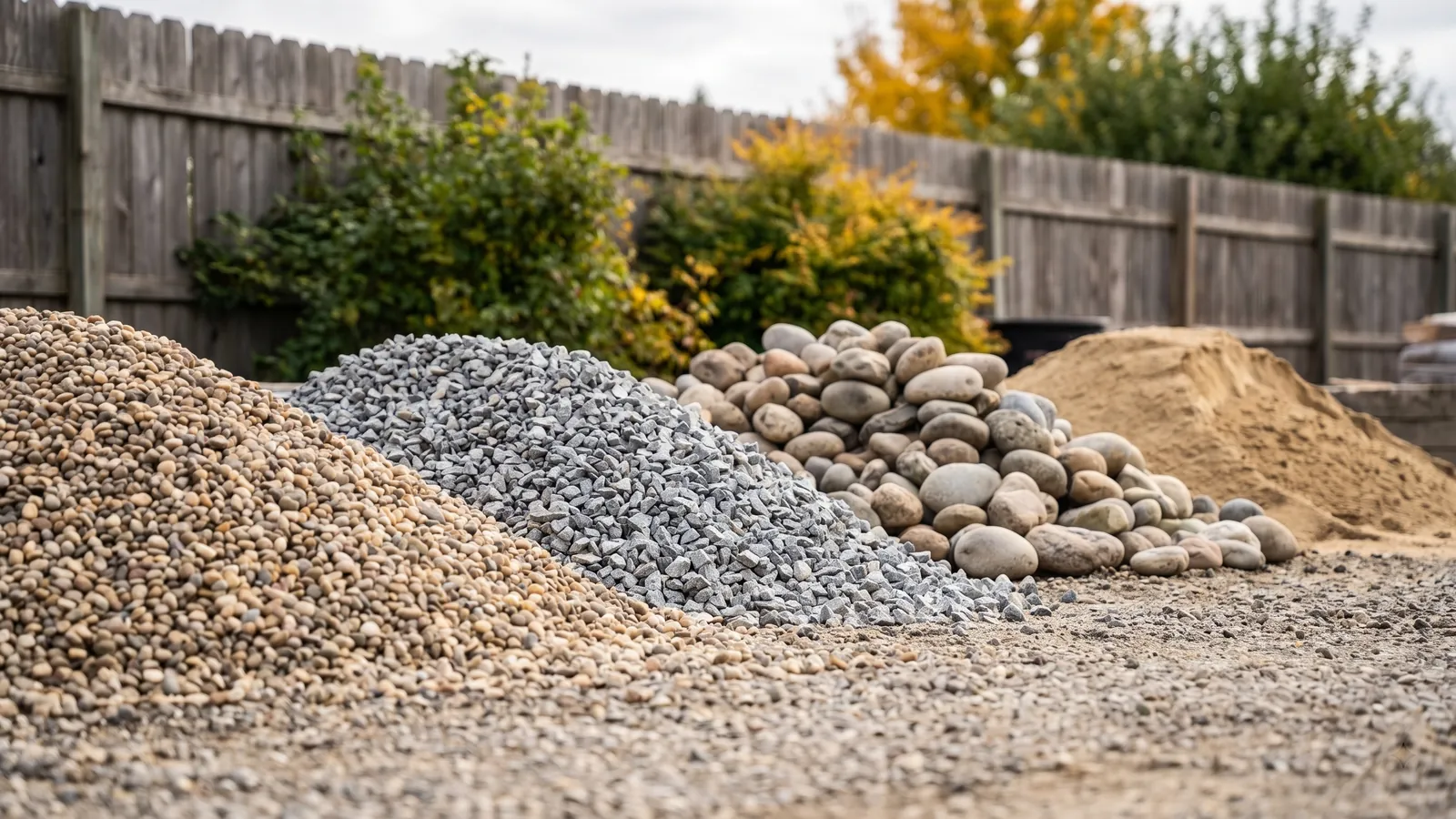
Which of our gravel calculators do you need?
Each stone has its own weight per cubic yard and its own depth, so each gets its own calculator. Pick the one that matches the material you are buying:
- Driveway, base or drainage: the crushed stone calculator (angular stone that compacts), or the gravel calculator if you're still comparing stone types.
- Path, patio or play area: the pea gravel calculator, with the CPSC depth for play areas built in.
- Dry creek bed or border: the river rock calculator, which sets the depth from the rock size.
- Decorative bed: the landscape rock calculator.
- Paver bedding, sandbox or leveling: the sand calculator.
How gravel calculators work
Every stone calculator runs the same three steps. Only the weight per yard and the recommended depth change from one material to another.
Worked example: a 20 × 10 ft area at 4 inches
200 sq ft × 4 in ÷ 12 = 66.7 cubic feet, or 2.47 cubic yards. With crushed stone at 1.4 tons per yard, that is about 3.5 tons. With pea gravel at 1.5 tons, 3.7 tons. Same area and depth, different stone, different order: that's why the material matters.
Stone and sand compared: weight, depth and coverage
Weights are Stone Center's ranges per cubic yard (sand from The Calculator Site); coverage is for one ton at the typical depth, using the mid-range weight.
| Material | Tons per cubic yard | Typical depth | 1 ton covers |
|---|---|---|---|
| Crushed stone | 1.35–1.7 | 4 in (base) | about 58 sq ft |
| Pea gravel | 1.4–1.6 | 2–3 in | 72–108 sq ft |
| River rock | 1.4–1.75 | 2–6 in by rock size | 36–108 sq ft |
| Landscape rock | 1.25–1.35 | 2–3 in | 83–125 sq ft |
| Dry sand | 1.35 | 1 in (paver bed) | about 240 sq ft |
Common project sizes
| Project | Size | Depth | Material | About |
|---|---|---|---|---|
| Garden path | 3 × 30 ft | 2 in | Pea gravel | 0.83 t |
| Patio base | 12 × 16 ft | 4 in | Crushed stone (+15% compaction) | 3.8 t |
| Shed pad | 10 × 12 ft | 4 in | Crushed stone (+10%) | 2.3 t |
| Dry creek bed | 4 × 30 ft | 4 in | River rock | 2.2 t |
| Single driveway | 12 × 60 ft | 6 in | Crushed stone | 18.7 t |
Bulk or bagged stone
A 0.5 cu ft bag is 1/54 of a cubic yard, so one ton of stone is roughly 36 to 40 bags. Bags suit small beds and repairs. From about half a ton up, bulk delivery by the ton is cheaper; ask for the minimum load and the delivery fee, and compare the totals the calculators give you.
Tons, cubic yards and bags: how stone is sold
Quarries weigh stone on a truck scale and sell it by the ton. Landscape yards often scoop it with a loader bucket and sell it by the cubic yard. Garden centers sell 0.5 cu ft bags. Every one of our gravel calculators gives all three, so you can compare quotes in the same unit.
To convert yourself: tons = cubic yards × tons per yard, and cubic yards = tons ÷ tons per yard. One cubic yard is 27 cubic feet, or 54 bags of 0.5 cu ft. A US ton is 2,000 lbs; a metric tonne is 1,000 kg, about 1.1 US tons.
Measuring odd shapes
Most stone jobs are not perfect rectangles. Split the area into rectangles, circles and triangles, measure each piece, and add the square feet. The square footage calculator does the adding and sends the total to any gravel calculator. For a circle, π × radius²; for a triangle, base × height ÷ 2, or Heron's formula from the three sides.
Measure the depth where it matters: after compaction for a base or a driveway, and at the thinnest point for decorative stone. A tape measure and a stake pushed into the ground are enough.
Landscaping and construction applications
Gravel, crushed stone and sand are all aggregate, and most outdoor projects use more than one. A patio takes a crushed stone base and a sand bed; a driveway takes a coarse base, a road base layer and a finer top; a planted bed may mix landscape rock with mulch. Work out each layer with its own calculator: every one multiplies length × width × depth, then applies that material's weight.
For larger construction and erosion work, the same logic scales up. A gravel road is a long driveway with a crown; riprap for a slope or a channel is sized by an engineer and sold by the ton; recycled concrete aggregate can replace quarried stone in some bases, if your supplier and local code allow it.
Estimating the cost of gravel, stone and sand
Price depends on the material, the size, the color and the distance from the quarry, so our calculators never guess it. Type your supplier's price per ton, per yard or per bag and each calculator multiplies it by the quantity, compares bags with bulk and marks the cheaper option.
- Local stone costs less. Limestone near one quarry, granite near another: whatever is crushed nearby travels less.
- Delivery is part of the price. A truckload has a minimum and a flat fee; on small orders it can cost as much as the stone.
- Tonnage vs volume. Compare quotes in the same unit, and ask whether the tonnage is weighed dry or wet.
- Waste and compaction. Add them before you compare, or the cheapest quote may run short.
Common mistakes when ordering stone
- Forgetting compaction. A base compacts, so order more than its finished volume. The crushed stone calculator adds the allowance.
- Using one weight for every stone. River rock and crushed stone don't weigh the same; the wrong density means the wrong tons.
- Going too shallow. A thin layer shows the ground, ruts and needs topping up. Use the depth for the job.
- Round stone on a driveway. Pea gravel and river rock roll under tires; driving surfaces need angular stone.
- No fabric or edging. Stone sinks into soft soil and spreads into the lawn without them.
Frequently asked questions
Are the gravel calculators free?
Yes. Every Terrainity gravel calculator is free, works on a phone, needs no account, and lets you download the estimate as a PDF report.
How much does 1 ton of gravel cover?
At 2 inches deep, one ton of crushed stone at about 1.4 tons per cubic yard covers roughly 115 sq ft. At 4 inches it covers about 58 sq ft. Heavier stone covers a little less per ton.
How many tons are in a yard of gravel?
Between about 1.25 and 1.75 tons depending on the stone, according to Stone Center: landscape gravels are lightest, river rock and crushed stone with fines are heaviest.
Which gravel is best for a driveway?
Angular crushed stone in layers: larger stone or crusher run for the base, #57 stone or crusher run on top. See the gravel driveway calculator and our driveway gravel guide.
Pick the gravel calculator that matches your stone, measure once, and download the PDF report with your tons, cubic yards and bags before you call the quarry.