On this page
- How much crushed stone do I need?
- How to use the crushed stone calculator
- Crushed stone sizes and where each goes
- Crushed stone tons by area and depth
- Cubic yards, tons and pounds
- Common crushed stone projects
- Crushed stone vs gravel, sand and river rock
- Crushed stone for roads, walls and foundations
- Waste and compaction factor
- Crushed stone cost and delivery
- Before you order crushed stone
- Frequently asked questions
How much crushed stone do I need?
Multiply area × depth to get cubic yards, add extra if you'll compact it, then multiply by the stone's weight: 1.35 to 1.7 tons per yard according to Stone Center. A 20 × 12 ft shed pad at 4 inches with 10% for compaction takes about 4.6 tons.
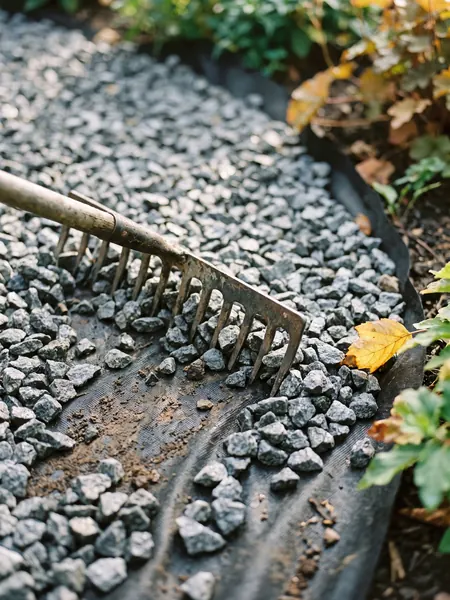
Crushed stone is rock broken in a crusher and screened by size into graded products: limestone, granite, trap rock and other local stone, each piece a few inches or less in diameter. The angular faces lock together when compacted, which is why it's the standard construction aggregate for bases, driveways and drainage.
Worked example: 240 sq ft × 4 in ÷ 12 = 80 cubic feet, or 2.96 cubic yards. Add 10% for compaction (3.26 yd³) and multiply by 1.4: about 4.6 tons of crushed stone.
How to use the crushed stone calculator
The crushed stone calculator follows the same order as a quarry estimate, and every step is written out in "How we calculated this" and in the PDF report.
Step 1: Enter the dimensions
Type the length and width in feet, or the square feet. For a circular area, use π × radius²; for odd shapes, the square footage calculator adds the pieces and sends the total here.
Step 2: Set the compacted depth
Enter the depth the layer will have after compaction: 2 to 3 inches for a path or top layer, 4 inches for a patio base or shed pad, 6 inches or more for a driveway base.
Step 3: Pick the stone weight
Clean stone without fines is lighter per yard than a dense-graded mix. Choose light (1.35), typical (1.4), with fines (1.5) or heavy (1.7) tons per yard, or ask your quarry for its exact figure.
Step 4: Add the compaction allowance
Loose stone shrinks when a plate compactor or roller packs it down. Our default adds 10%; set it to what your supplier recommends for their product, or to zero for decorative stone spread loose.
Crushed stone sizes and where each goes
Crushed stone is sold by size number, which names a range of particle sizes. Typical ranges from Hello Gravel and The Brickyard:
| Stone | Size | Typical layer or use |
|---|---|---|
| #3 or #4 stone | About 1½–2½ in | Bottom layer of a driveway, heavy base |
| #57 stone | About ¾–1 in | Middle or top layer; around drain pipes (ICPI Tech Spec 2) |
| #8 stone | About ⅜ in | Thin top dressing |
| #411 / crusher run | ¾ in stone with fines | Compacted base for driveways, pads and walkways |
| Stone dust / screenings | Fines | Not as paver bedding: ICPI says to use concrete sand |
Clean stone (#57, #8) has no fines, so water runs straight through it. Dense-graded stone with fines packs almost like concrete but drains slower. Many builds combine them: a compacted dense-graded base with clean stone on top.
Crushed stone tons by area and depth
At 1.4 tons per cubic yard, loose volume, no compaction allowance.
| Area (sq ft) | 2 in | 4 in | 6 in | 8 in | Cubic yards (4 in) |
|---|---|---|---|---|---|
| 100 | 0.86 t | 1.73 t | 2.59 t | 3.46 t | 1.23 yd³ |
| 250 | 2.16 t | 4.32 t | 6.48 t | 8.64 t | 3.09 yd³ |
| 500 | 4.32 t | 8.64 t | 12.96 t | 17.28 t | 6.17 yd³ |
| 1,000 | 8.64 t | 17.28 t | 25.93 t | 34.57 t | 12.35 yd³ |
| 2,000 | 17.28 t | 34.57 t | 51.85 t | 69.14 t | 24.69 yd³ |
Cubic yards, tons and pounds
Quarries sell crushed stone by the ton; some landscape yards sell it by the cubic yard. One ton at 1.4 tons per yard is about 0.71 cubic yards, or 19 cubic feet. In pounds, a yard of crushed stone weighs about 2,700 to 3,400 lbs, and moisture adds more.
For a metric quote, one cubic yard is 0.765 cubic meters and one US ton is 0.907 tonnes.
Common crushed stone projects
Driveways
Large stone or crusher run below, #57 on top, 4 to 6 inches or more in total. The gravel driveway calculator splits the tons by layer.
Paver and slab bases
ICPI Tech Spec 2 calls for at least 4 inches of compacted base under patios and walkways, 6 inches under driveways. See the paver base calculator.
Drainage and French drains
Clean stone around a perforated pipe lets water reach it and flow away. Wrap the trench in geotextile so soil doesn't clog the stone.
Shed pads and walkways
A compacted crushed stone pad under a shed keeps it level and dry; on a walkway, a smaller stone gives a firm, stable surface.
Edges and fabric
On soft soil, a geotextile under the stone stops it sinking into the ground. Along lawns and beds, an edge keeps it from spreading.
Crushed stone vs gravel, sand and river rock
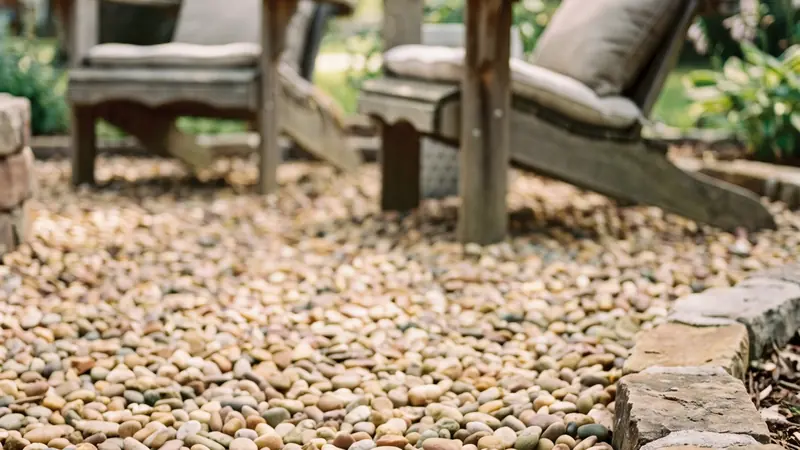
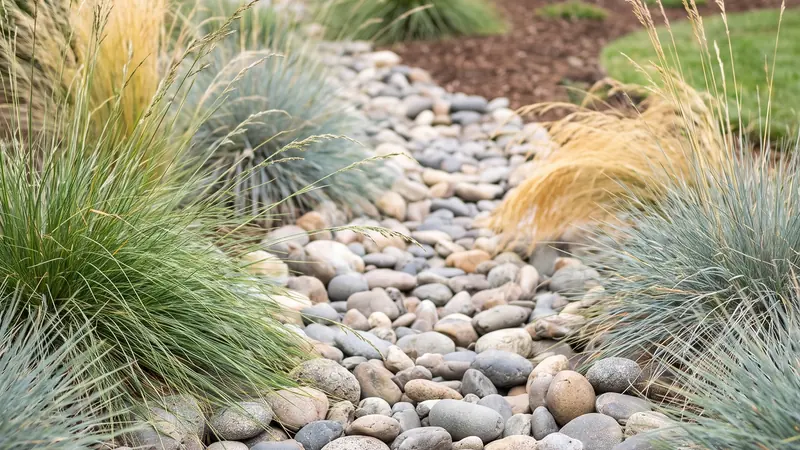
"Gravel" often means any small stone, but crushed stone is manufactured and angular, while natural gravel, pea gravel and river rock are rounded by water. Rounded stone looks softer and drains well, yet it never locks together, so it moves under feet and tires. For decorative purposes in a garden bed, either works; mulch is the softer alternative around plants. Sand is the fine end of the same aggregate family and is used for bedding and leveling, not for bearing weight on its own.
Crushed stone for roads, walls and foundations
Beyond driveways, crushed stone is the working aggregate of most construction projects. Gravel roads use the same layered build as a driveway at a larger scale: coarse stone at the bottom, a dense-graded road base in the middle, and a surface layer shaped with a crown so water runs off. The road base calculator handles that middle layer.
Behind a retaining wall, clean crushed stone fills the drainage zone so water can't build up pressure against the blocks, and a compacted base of crushed stone sits under the first course. Under a slab or a foundation footing, a few inches of compacted stone give a level, well-drained surface. Under asphalt, the stone base carries the load while the asphalt seals the top.
Waste and compaction factor
Two factors make the order bigger than the raw volume. Compaction shrinks loose stone, and uneven ground, spills and stone lost into soft subgrade add waste. The calculator applies one combined allowance you choose. Coarse, clean stone compacts less than a mix with fines, and on a slope, on soft fill or where erosion is a risk you may need more. Shape the final grade so water runs off the building and the stone.
Crushed stone cost and delivery
For material cost, crushed stone is one of the cheapest aggregates per ton because it's quarried locally almost everywhere, but delivery can cost as much as the stone on small loads. Enter your supplier's price per ton and check the truck capacity: a load that just exceeds one truck may mean paying for two trips.
Before you order crushed stone
Measure the area, set the compacted depth, pick the stone weight and the compaction allowance, and the crushed stone calculator gives you the quantity in tons and cubic yards for any landscaping or building project. Confirm the size number and density with your quarry, and take the PDF report with you.
Frequently asked questions
How much crushed stone do I need?
Multiply the area in square feet by the depth in inches, divide by 12 and by 27 for cubic yards, add extra if you will compact it, then multiply by about 1.4 tons per yard. A 20 × 12 ft pad at 4 inches with 10% extra needs about 4.6 tons.
How much does a yard of crushed stone weigh?
Stone Center lists crushed stone at 1.35 to 1.7 tons (2,700 to 3,400 lbs) per cubic yard, depending on the rock and the size. Stone with fines, like crusher run, is at the heavy end.
How much area does a ton of crushed stone cover?
At about 1.4 tons per cubic yard, one ton covers roughly 115 sq ft at 2 inches, 77 sq ft at 3 inches and 58 sq ft at 4 inches, before compaction.
What size crushed stone should I use?
It depends on the layer. Large stone such as #3 or #4 (about 1½ to 2½ in) carries the load at the bottom of a driveway; #57 (about ¾ to 1 in) drains well as a middle or top layer; crusher run or #411 packs hard as a base.
Should I order extra crushed stone for compaction?
Yes, if the stone is a base you will compact. Compacted stone takes less room than loose stone, so order a little more than the finished volume. Ask your supplier how much their product shrinks.
How accurate is the crushed stone calculator?
The math is exact for your dimensions. Accuracy depends on the stone's real weight per yard and on the compaction allowance, so enter your supplier's density and round the order up.
Sources