On this page
- How much landscape rock do I need?
- How to use the landscape rock calculator
- Recommended depth by rock size
- Landscape rock tons by bed size
- Types of landscape rock
- Preparing the bed
- Planning tips for landscape rock
- Other landscape materials
- Cubic yards, tons and pounds
- Landscape rock cost and delivery
- Before you order landscape rock
- Frequently asked questions
How much landscape rock do I need?
Area × depth gives you cubic yards; multiply by about 1.3 tons per yard for decorative landscape gravel (Stone Center: 1.25 to 1.35 tons). A 200 sq ft front bed at 2 inches takes 1.23 cubic yards, about 1.6 tons of rock.
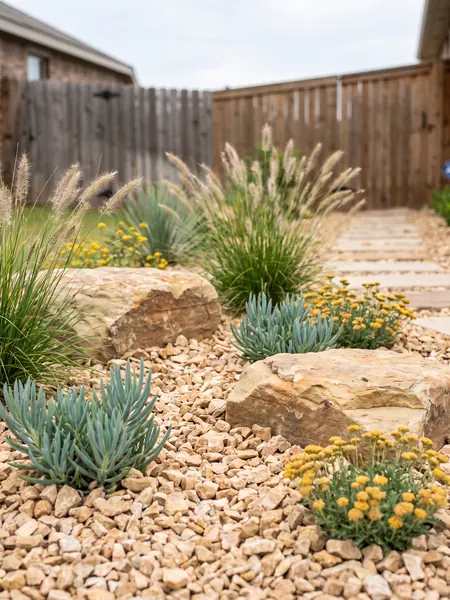
Landscaping rock covers beds, borders and bare ground without breaking down like mulch. It comes in many colors and sizes, from ⅜ inch chips and crushed limestone to 2 inch stone and boulders, and each size needs its own depth to hide the soil.
Worked example: a bed 20 ft long and 10 ft wide is 200 square feet. At 2 inches deep: 200 × 2 ÷ 12 = 33 cubic feet, divided by 27 = 1.23 cubic yards. At 1.3 tons per yard, that's about 1.6 tons, or 67 bags of 0.5 cu ft.
How to use the landscape rock calculator
The landscape rock calculator needs your bed size, the depth and the rock weight. It returns the cubic yards, tons and bags, and adds the cost if you type in prices.
Step 1: Measure the bed in square feet
Take the measurement of each bed. For a rectangular bed, multiply length × width in feet. For a circle, measure the diameter, halve it for the radius, and use π × radius². For a triangle, base × height ÷ 2. Irregular beds go through the square footage calculator, which adds the pieces. The rest of the formula is the same: square feet × depth ÷ 12 ÷ 27.
Step 2: Choose the recommended depth
Use 2 inches for small rock, 3 inches for 1 to 2 inch rock and 4 inches for larger stone. Enter the depth in inches; the calculator converts it to feet for the volume.
Step 3: Pick the material weight
Landscape gravels weigh about 1.25 to 1.35 tons per cubic yard. The default is 1.3; choose light or heavy, or type in your supplier's weight for the exact product.
Step 4: Choose bags or bulk and check the cost
Bags hold 0.5 cubic feet, so a cubic yard is 54 bags. Enter your prices to compare the bagged and bulk totals, then download the PDF report for the order.
Recommended depth by rock size
| Rock size | Recommended depth | Coverage of 1 ton (1.3 t/yd³) |
|---|---|---|
| ⅜–¾ in (small chips) | 2 in | about 125 sq ft |
| 1–2 in | 3 in | about 83 sq ft |
| 2–4 in | 4 in | about 62 sq ft |
| Boulders and accents | Set individually | Priced per piece or per ton |
Landscape rock tons by bed size
At 1.3 tons per cubic yard. Bags are 0.5 cubic feet at a 2 inch depth, rounded up.
| Area (sq ft) | 2 in | 3 in | 4 in | Cubic yards (2 in) | Bags (2 in) |
|---|---|---|---|---|---|
| 100 | 0.80 t | 1.20 t | 1.60 t | 0.62 yd³ | 34 |
| 250 | 2.01 t | 3.01 t | 4.01 t | 1.54 yd³ | 84 |
| 500 | 4.01 t | 6.02 t | 8.02 t | 3.09 yd³ | 167 |
| 1,000 | 8.02 t | 12.04 t | 16.05 t | 6.17 yd³ | 334 |
| 2,000 | 16.05 t | 24.07 t | 32.10 t | 12.35 yd³ | 667 |
Types of landscape rock
Decorative gravel
Crushed or screened stone in white, tan, gray or red, sold in small sizes for beds and borders. The most common landscaping rock.
River rock
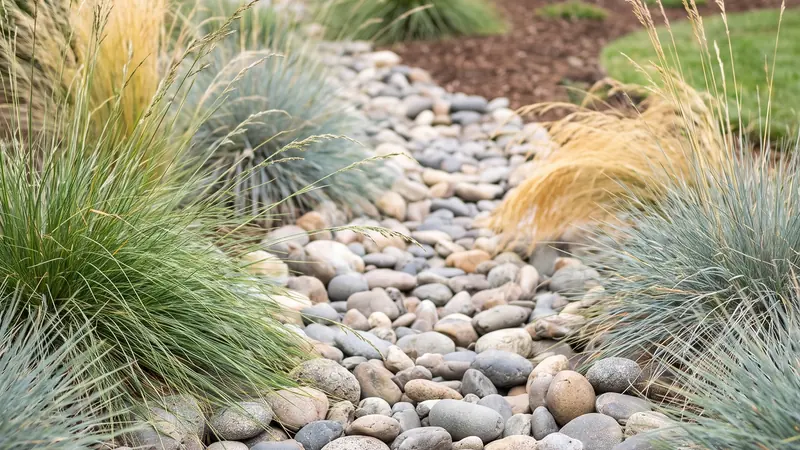
Smooth, rounded stones, larger and heavier per yard. Best for dry creek beds and drainage. See the river rock calculator.
Pea gravel
Small rounded stone that works for paths and patios as well as beds. See the pea gravel calculator.
Lava rock and decomposed granite
Lava rock is light and porous, with bold red or black color. Decomposed granite packs into a firm, natural-looking surface for paths and xeriscape beds.
Preparing the bed
Remove weeds and grass from the flower bed, rake out uneven ground and lay a woven landscape fabric so weeds can't push through and the rock doesn't sink. Install edging before the rock goes down; it keeps the stone out of the lawn and gives the bed a clean line.
Rock gets hot
Light rock reflects heat onto walls and plants, and dark rock absorbs it. Around thirsty plants, mulch is often the better cover. Our mulch vs rock guide compares them side by side.
Planning tips for landscape rock
- Measure every bed. Take the length and width of each one, or its square footage, and add them before you order: small beds add up.
- Choose one size per bed. Mixed sizes settle unevenly; if you want contrast, use a border of larger stone around a bed of smaller rock.
- Allow for settling. Rock sinks a little into the fabric and soil in the first season. Rounding up the order covers it.
- Get a quote with delivery. Ask for the price per ton, the delivery fee and the minimum load before you compare with bags.
Other landscape materials
Many landscape material calculators mix rock, mulch, soil and sand in one tool. Each material has its own weight and depth, so Terrainity keeps a calculator for each: mulch for planted beds, topsoil for leveling and lawns, sand for bedding and leveling, and gravel for paths and driveways. Washed gravel, with the fines rinsed out, is a good choice for a walkway or a drainage bed where you want water to pass straight through. Under concrete, pavers or a shed foundation, the base material is compacted crushed stone, not decorative rock.
Cubic yards, tons and pounds
Most suppliers sell landscape rock by the ton or by the cubic yard. At 1.3 tons per yard, one ton is about 0.77 cubic yards, or 21 cubic feet, and a yard weighs about 2,600 lbs. A 0.5 cu ft bag weighs roughly 48 lbs at that density.
Landscape rock cost and delivery
Price depends on the stone, the color and how far it travels. The calculator uses the price per ton and per bag you enter. For a large project, bulk delivery is usually cheaper; check the supplier's minimum, which is often about a cubic yard, and add delivery before comparing.
Before you order landscape rock
Measure every bed, choose the depth for your rock size and let the landscape rock calculator turn it into tons, cubic yards and bags. Prep the bed with fabric and edging, confirm the weight per yard with your supplier, and download the PDF report for your landscaping project.
Frequently asked questions
How much landscape rock do I need?
Multiply length × width × depth in feet and divide by 27 for cubic yards, then multiply by about 1.3 tons per yard for decorative landscape gravel. A 200 sq ft bed at 2 inches needs 1.23 cubic yards, about 1.6 tons.
How much does landscape rock weigh?
Stone Center lists landscape gravels at about 1.25 to 1.35 tons (2,500 to 2,700 lbs) per cubic yard. Larger decorative rock and boulders weigh more per piece and cover less per ton.
How deep should landscape rock be?
About 2 inches for small rock (under an inch) and 3 inches for 1 to 2 inch rock, over landscape fabric. Go deeper for larger stone so the ground doesn't show between the pieces.
How many bags of landscape rock make a cubic yard?
A cubic yard is 27 cubic feet, so it takes 54 bags of 0.5 cubic feet. Most suppliers set a minimum bulk order, often around one cubic yard.
Is landscape rock cheaper than mulch?
Rock usually costs more up front but doesn't break down, so it isn't replaced every year or two like mulch. Mulch feeds the soil; rock doesn't. Our mulch vs rock guide compares them.
How accurate is the landscape rock calculator?
It is exact for the area and depth you enter. Measure each bed carefully, use the depth that suits your rock size, and ask the supplier for the weight per yard of the exact product.
Sources