On this page
- How much river rock do I need?
- How to use the river rock calculator
- River rock size and depth
- River rock tons by area and depth
- River rock in cubic yards, tons and pounds
- Where river rock works best
- River rock vs gravel and mulch
- Planning a dry creek bed
- Water features, drains and slopes
- River rock cost and delivery
- Before you order river rock
- Frequently asked questions
How much river rock do I need?
Find the volume in cubic yards (length × width × depth ÷ 27), then multiply by about 1.5 tons per cubic yard, the middle of Stone Center's 1.4 to 1.75 ton range. A 100 sq ft bed at 3 inches needs 0.93 yd³, about 1.4 tons of river rock.
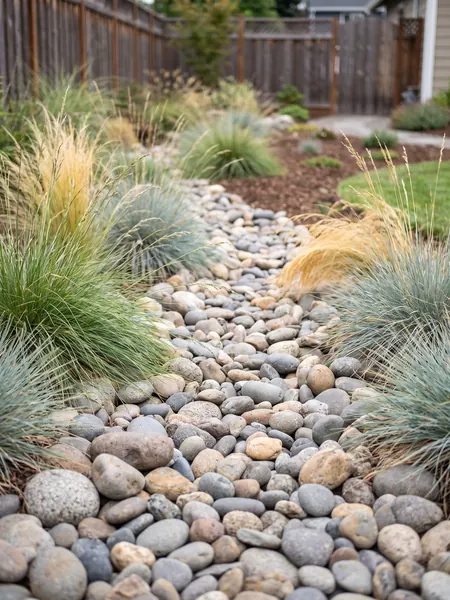
River rock is a smooth, rounded type of aggregate shaped by moving water, sold in a variety of colors and in sizes from about ¾ inch to 5 inches in diameter and larger. Landscaping and construction suppliers grade it by size. Because the stones are round, they don't pack like crushed stone, and bigger rock leaves bigger gaps. That is why the depth has to follow the rock size.
Worked example: a dry creek bed 30 ft long and 4 ft wide, filled 4 inches deep with 1 to 3 inch rock. That is 120 sq ft × 0.33 ft = 40 cubic feet, or 1.48 cubic yards. At 1.5 tons per yard, order about 2.2 tons.
How to use the river rock calculator
The river rock calculator turns four inputs into the volume, the weight and the number of bags to buy. Each step appears in "How we calculated this" and in the PDF report you can hand to your supplier.
Step 1: Measure length and width in feet
Enter each dimension of the bed, border or creek bed (the length and width), or the square feet if you know them. The formula is the same for every application. For a winding creek bed, measure it in straight sections and add them in the square footage calculator.
Step 2: Match the depth to the rock size
Pick the rock size you're buying and the calculator suggests the depth: small rock needs 2 to 3 inches, large rock 4 to 6. A layer about twice the stone size is our rule of thumb for hiding the ground.
Step 3: Choose the stone weight
River rock density varies with the stone and its size. The calculator uses 1.5 tons per cubic yard by default, and lets you switch to light (1.4) or large, dense rock (1.75). Your supplier's figure for the exact product is always better.
Step 4: Compare bulk and bags
Garden centers sell river rock in 0.5 cu ft bags; landscape suppliers sell it loose by the ton or the yard. Enter both prices and the calculator shows the total cost of each, with the cheaper option marked.
River rock size and depth
Larger stones leave bigger gaps, so the layer has to be thicker to cover the ground. Our rule of thumb is about twice the stone size:
| Rock size | Typical use | Layer depth | 1 ton covers (1.5 t/yd³) |
|---|---|---|---|
| ¾–1½ in | Beds, borders, around plants | 2–3 in | 72–108 sq ft |
| 1–3 in | Dry creek beds, drainage swales | 3–4 in | 54–72 sq ft |
| 3–5 in | Creek beds, slopes, accents | 4–6 in | 36–54 sq ft |
| 6 in and up (cobbles) | Edges, erosion control, water features | One stone deep | Ask your supplier |
River rock tons by area and depth
Coverage at 1.5 tons per cubic yard. Divide by 1.5 and multiply by your supplier's weight if theirs differs.
| Area (sq ft) | 2 in | 3 in | 4 in | 6 in | Cubic yards (3 in) |
|---|---|---|---|---|---|
| 100 | 0.93 t | 1.39 t | 1.85 t | 2.78 t | 0.93 yd³ |
| 250 | 2.31 t | 3.47 t | 4.63 t | 6.94 t | 2.31 yd³ |
| 500 | 4.63 t | 6.94 t | 9.26 t | 13.89 t | 4.63 yd³ |
| 1,000 | 9.26 t | 13.89 t | 18.52 t | 27.78 t | 9.26 yd³ |
| 2,000 | 18.52 t | 27.78 t | 37.04 t | 55.56 t | 18.52 yd³ |
River rock in cubic yards, tons and pounds
Suppliers quote river rock by the ton or by the cubic yard. At 1.5 tons per yard, one ton is about 0.67 cubic yards, or 18 cubic feet. In pounds, that is 3,000 lbs per yard, and a 0.5 cu ft bag weighs about 55 lbs.
Stone Center gives 1.4 tons per yard for lighter river rock and up to 1.75 tons for heavier stone. Wet rock weighs more for the same volume. When you compare quotes, convert both to the same unit first.
Where river rock works best
Dry creek beds
A channel lined with mixed sizes of river rock carries runoff across a yard and looks natural when the water is gone.
Drainage and erosion control
Rounded stone along downspouts and swales slows water and keeps soil from washing out. For heavy flows on slopes, larger rock or riprap holds better.
Beds and borders
Low-maintenance ground cover around shrubs and in xeriscape beds, with no mulch to replace every year.
Not for walking or driving
Round stones roll underfoot and under tires. For paths use the pea gravel calculator; for a driveway, crushed stone.
Put fabric down first
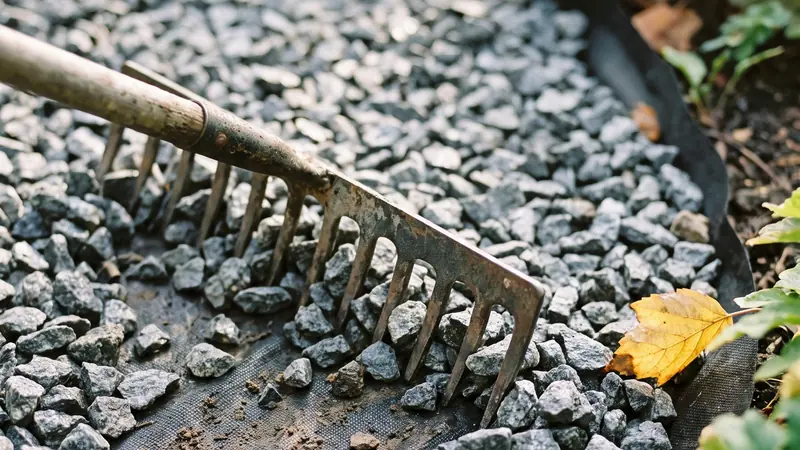
River rock sinks into bare soil and weeds push up between the stones. Lay landscape fabric first, edge the bed, and the rock stays clean on top for years.
River rock vs gravel and mulch
River rock is heavier and pricier per square foot than mulch, but it doesn't break down or blow away, so there's nothing to top up each spring. Compared with crushed stone, it drains just as well but never compacts into a firm surface, which is why it stays in beds and channels rather than on paths.
Mixing sizes is common in dry creek beds: larger stones along the edges, 1 to 3 inch rock in the channel. Calculate each size separately with its own depth and add the totals, or see the landscape rock calculator for smaller decorative stone.
Planning a dry creek bed
A dry creek bed is the most common river rock project, and the one people most often under-order. Planning it in this order keeps the quantity right:
- Follow the water. Lay the channel where runoff already flows, from a downspout or a low spot toward a drain or a lower part of the yard.
- Dig and line it. Excavate a shallow, dish-shaped channel a few inches deep and line it with landscape fabric to prevent erosion under the stones and stop weeds.
- Measure each section. Take the length and width of every straight run and add them; a curved channel is several short rectangles.
- Place the boulders first. Set larger stones and boulders along the banks, then fill the channel with 1 to 3 inch rock. Calculate each size separately.
Water features, drains and slopes
Around a water feature or pond edge, river rock hides the liner and softens the transition to the lawn. Along a French drain it lets water reach the pipe while keeping the surface clean. On a slope where water flow is strong, choose larger stone: small rounded rock can wash downhill, and very heavy flows call for riprap sized by an engineer.
Next to concrete, pavers or a driveway, an edge restraint stops the rock from spreading onto the pavement. Decorative rock of mixed colors and sizes gives the most natural look; a single size and color looks more formal.
River rock cost and delivery
Pricing depends on the size, the color and the distance from the supplier, so the calculator uses the prices you enter from your local landscape supply yard. Bulk river rock is usually priced per ton; bags cost more per ton but need no delivery. Add the delivery fee to bulk before you compare, and ask about the minimum load.
Before you order river rock
Measure the area, choose the rock size and depth, and let the river rock calculator give you the tons, cubic yards and bags. Ask your supplier for the weight of the exact product, lay fabric and edging first, and download the PDF report to take with you.
Frequently asked questions
How much river rock do I need?
Multiply the area in square feet by the depth in inches, divide by 12 and then by 27 for cubic yards, and multiply by about 1.5 tons per yard. A 30 × 4 ft dry creek bed at 4 inches needs 1.48 cubic yards, about 2.2 tons.
How much does a yard of river rock weigh?
Stone Center lists river rock at about 1.4 to 1.75 tons (2,800 to 3,500 lbs) per cubic yard. Bigger, denser stone sits at the top of that range.
How much area does a ton of river rock cover?
At 1.5 tons per cubic yard, one ton covers about 108 sq ft at 2 inches deep, 72 sq ft at 3 inches and 54 sq ft at 4 inches. Larger rock needs a deeper layer, so it covers less per ton.
How deep should river rock be?
Deep enough to hide the fabric or soil below. A handy rule is a layer about twice as thick as the stones are wide: 2 to 3 inches for ¾ to 1½ inch rock, 4 to 6 inches for 3 to 5 inch rock.
Do I need landscape fabric under river rock?
It helps. River rock sinks into bare soil and weeds push up between the stones; a woven landscape fabric under the rock keeps it clean and on top for years.
Is the river rock calculator accurate for large stones?
Yes, as long as the depth matches the stone size. Large rock leaves bigger gaps, so pick the depth for your rock size in the calculator and ask your supplier for the weight of that exact product.
Sources