On this page
- How much fill dirt do I need?
- How to use the fill dirt calculator
- Fill dirt by area and depth
- How much extra fill dirt for compaction?
- Fill dirt, select fill, structural fill and topsoil
- Fill dirt weight and truckloads
- Grading and drainage
- Cut and fill on a sloped lot
- Fill dirt cost
- Common fill dirt mistakes
- Before you order fill dirt
- Frequently asked questions
How much fill dirt do I need?
Area × fill depth ÷ 27 gives the cubic yards of finished fill. Add an allowance for compaction, because loose fill shrinks when it is tamped or rolled. A 30 × 20 ft area filled 12 inches deep takes about 25.6 cubic yards.
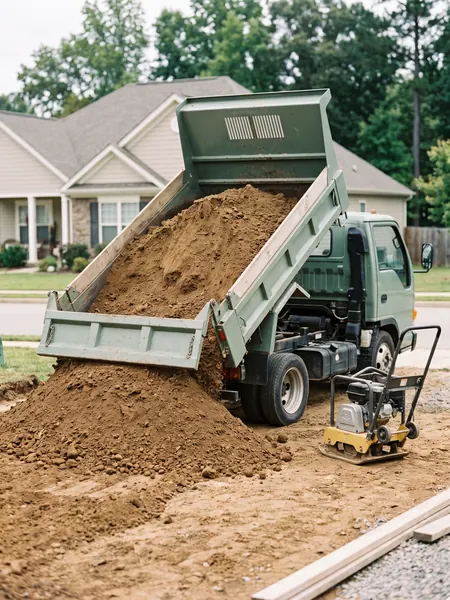
Raising a 30 × 20 ft low spot by 12 inches takes 600 cu ft = 22.2 yd³ finished. With 15% for compaction, order 25.6 yd³, about 31 tons at 1.2 tons per yard.
How to use the fill dirt calculator
The fill dirt calculator turns the area and the fill depth into cubic yards, tons and truckloads. The "How we calculated this" panel shows each step, and the PDF report keeps them for your hauler.
Step 1: Measure the area to fill
Enter the length and width in feet, or the square feet if you know them. For odd shapes, add the pieces in the square footage calculator first.
Step 2: Set the fill depth
Use the average depth of fill after compaction. For a slope, average the shallow and deep ends: a wedge that runs from 0 to 12 inches averages 6 inches.
Step 3: Add compaction and pick the moisture
Choose 10 to 25 percent extra, then dry, moist or wet soil for the weight. The default is 15 percent and moist soil.
Step 4: Read the order
You get cubic yards, tons and the number of truckloads for the truck size you enter. Add the price per yard to see the cost.
Fill dirt by area and depth
Cubic yards before compaction allowance.
| Area (sq ft) | 6 in | 12 in | 24 in | 36 in |
|---|---|---|---|---|
| 100 | 1.9 yd³ | 3.7 yd³ | 7.4 yd³ | 11.1 yd³ |
| 250 | 4.6 yd³ | 9.3 yd³ | 18.5 yd³ | 27.8 yd³ |
| 500 | 9.3 yd³ | 18.5 yd³ | 37.0 yd³ | 55.6 yd³ |
| 1,000 | 18.5 yd³ | 37.0 yd³ | 74.1 yd³ | 111.1 yd³ |
| 2,000 | 37.0 yd³ | 74.1 yd³ | 148.1 yd³ | 222.2 yd³ |
How much extra fill dirt for compaction?
A truck delivers loose soil. Once a plate compactor or roller passes over it, the same soil takes up less room, so you order more than the finished volume.
| Fill | Extra to order | Source |
|---|---|---|
| General residential fill | About 15% | CalcSummit |
| Granular or sandy fill | 10 to 12% | CalcSummit |
| Clay-heavy or structural fill | 20 to 25% | CalcSummit |
| Fill compacted in lifts | 15 to 25% | Soil Depot |
For structural fill under a foundation, wall or road base, the target density comes from ASTM D698, the Standard Proctor test. CalcSummit says most residential structural specs call for 95 percent of maximum dry density.
Compact in layers
Spread fill in thin lifts and compact each one before adding the next. Dumping it all at once and compacting the top leaves soft ground that settles for years.
Fill dirt, select fill, structural fill and topsoil
Fill dirt
Unscreened, rough soil for raising grade and filling holes. Not for planting on its own.
Select fill
A fill product suppliers sell apart from plain fill dirt, often for firmer bases. Ask your yard exactly what is in it.
Structural fill
Engineered, compacted fill under foundations, slabs and walls, built to a density spec.
Topsoil
Screened organic soil for the top layer. See the topsoil calculator.
Soil Depot notes that 3 to 4 inches is typical for a topsoil dressing and 6 to 12 inches for building up grade. Fill goes under and topsoil goes on top.
Fill dirt weight and truckloads
Fill dirt is ordered by the cubic yard but often weighed by the ton. The Calculator Site gives roughly 1 to 1.35 tons per cubic yard, and wet soil weighs more. Truck size sets the number of loads, and Soil Depot says a tandem dump truck carries about 10 to 18 cubic yards.
Grading and drainage
UMD Extension says an ideal slope away from buildings has a 1 to 2 percent grade, a drop of 1¼ to 2½ inches every 10 feet. Do not create a slope toward a building. Plan the fill so water runs away from the foundation.
Cut and fill on a sloped lot
On a slope you can cut soil from the high side and use it to fill the low side. Work out the volume of each part, then compare them. If the cut is less than the fill, you order the difference. Leave room for compaction and for topsoil on top.
Big grade changes
Filling against a foundation, behind a wall or under a building or driveway can need permits and engineered fill. Check with your local building department first.
Fill dirt cost
Haulers usually sell fill by the cubic yard or by the truckload, and often deliver it. Enter your price per yard and the calculator adds up the total. Some fill is free from construction sites, but you still pay for the trucking, and you should check what is in it.
Finishing with a layer plants can grow in? Put topsoil on top.
Topsoil calculatorCommon fill dirt mistakes
- Skipping compaction. Order the extra, or the fill finishes below grade.
- Using it to plant. It has little organic matter. Cap it with topsoil.
- Ignoring the slope. Grade the fill away from the house at 1 to 2 percent.
- Guessing the depth. Measure at several points and use the average.
Before you order fill dirt
Measure the area, set the average depth, add the compaction for your soil, and let the fill dirt calculator give you cubic yards, tons and truckloads. Confirm the load size and price with your hauler, and download the PDF report.
Frequently asked questions
How much does a yard of fill dirt weigh?
Roughly 1 to 1.35 tons (2,000 to 2,700 lb) per cubic yard, like topsoil, depending on moisture. Soaked soil can weigh up to 50% more, according to The Calculator Site.
How much extra fill dirt should I order for compaction?
Soil Depot suggests adding roughly 15 to 25 percent for fill that will be compacted in lifts. CalcSummit puts sandy fill at 10 to 12 percent and clay-heavy fill at 20 to 25 percent. Our default adds 15%.
What is the difference between fill dirt and topsoil?
Fill dirt is subsoil with little organic matter: it compacts and stays put, so it's used to raise grade. Topsoil is the organic top layer that plants grow in. Fill goes under, topsoil goes on top.
How many yards of dirt are in a dump truck?
Soil Depot says a standard tandem dump truck carries about 10 to 18 cubic yards depending on the truck and the material. Enter your truck size and the calculator gives the number of loads.
How much fill dirt do I need for a 10 × 10 ft area 6 inches deep?
10 × 10 ft × 0.5 ft is 50 cubic feet, or 1.85 cubic yards. With 15% for compaction, order about 2.1 cubic yards, roughly 2.6 tons at 1.2 tons per yard.
How accurate is the fill dirt calculator?
It gives the exact volume for the area and depth you enter, plus an allowance for compaction and a weight from the moisture you pick. Ground is rarely flat, so measure the depth at several points, use the average and confirm the load size with your hauler.
How do I calculate fill for a sloped area?
Use the average depth. A 40 × 20 ft area that slopes from 0 to 12 inches deep has an average depth of 6 inches, so it takes 800 sq ft × 0.5 ft = 400 cubic feet, or 14.8 cubic yards, before compaction.
Sources