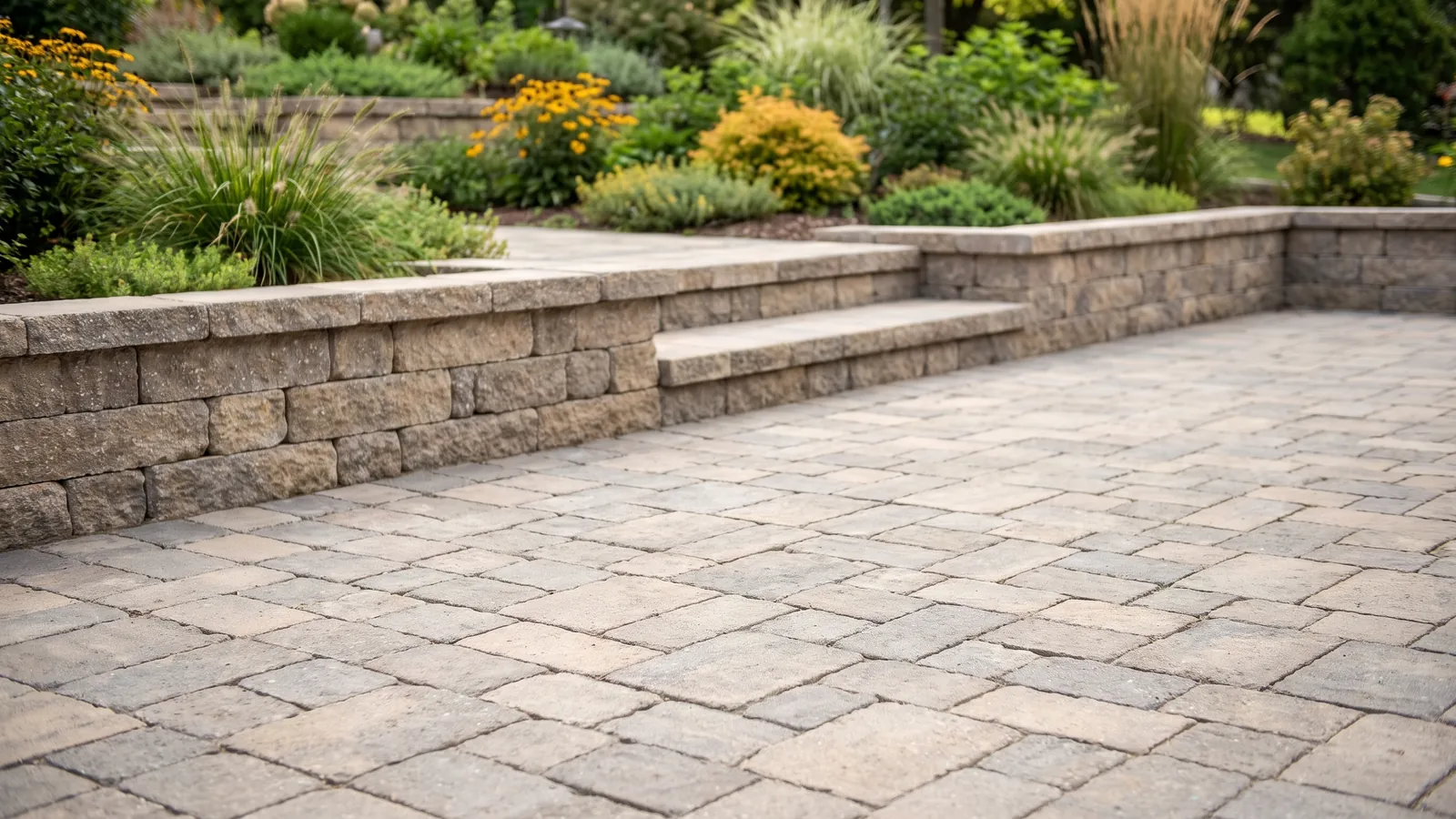
Which of our patio calculators do you need?
A patio is a stack of layers, and each layer has its own calculator. Start with the surface you chose, then work down:
- Concrete pavers: the paver calculator, for the number of pavers with waste, plus base and sand in one list.
- The base under the pavers: the paver base calculator, for compacted aggregate in tons.
- The bedding layer: the paver sand calculator, for the 1 inch of concrete sand under the pavers.
- The joints: the polymeric sand calculator, for bags of sand that lock the pavers together.
- Natural stone: the flagstone calculator, for tons and pallets by stone thickness.
- A poured slab: the concrete calculator, for cubic yards, bags and ready-mix.
- A wall beside the patio: the retaining wall calculator, for blocks, caps, base and drainage stone.
How patio calculators work
Every patio calculator multiplies the area by a thickness or a coverage rate, adds waste, and converts the result to what the supplier sells: pieces, tons, bags or cubic yards.
Worked example: a 12 × 16 ft paver patio
The patio is 192 sq ft. With 6 × 9 in pavers and 10% extra, the paver calculator gives 564 pavers. A 4 inch base is 2.37 cubic yards, or 3.32 tons, and a 1 inch bed of sand is 0.59 cubic yards, or 0.80 tons. The joints take 3 bags of 50 lb polymeric sand at 1/8 inch. That is one shopping list from four calculators.
The layers of a patio
ICPI Tech Spec 2 sets the minimums for an interlocking paver patio over well-drained soil. Colder climates and weak soils need a thicker base.
| Layer | Patio or walkway | Calculator |
|---|---|---|
| Compacted aggregate base | 4 in minimum | Paver base |
| Bedding sand (concrete sand) | 1 in, uncompacted | Paver sand |
| Concrete pavers | 2⅜ in | Paver |
| Joint sand | Full joint depth | Polymeric sand |
Pavers vs flagstone vs concrete
The three surfaces are ordered in different units, so their calculators differ. This table gives the sourced basics.
| Pavers | Flagstone | Poured concrete | |
|---|---|---|---|
| You order | Pieces or pallets | Tons or pallets | Cubic yards or bags |
| Typical thickness | 2⅜ in (ICPI) | 1 to 3 in (Acme) | 4 in for patios (Concrete Network) |
| Under it | 4 in base, 1 in sand | 4 in base, 1 in sand (Earth Stone Rock) | Formed slab, often on gravel |
| Joints | 1/16 to 3/16 in, polymeric sand | Sand, stone dust, pea gravel or polymeric sand | Control joints |
| Waste | 5 to 15% | About 10% | 5 to 10% |
Common patio sizes
Quantities for a paver patio with 6 × 9 in pavers, 10% extra, a 4 inch base and a 1 inch sand bed, using the calculators' weights of 1.4 tons per yard for base and 1.35 for sand.
| Patio | Area | Pavers | Base | Sand | Concrete slab, 4 in |
|---|---|---|---|---|---|
| 10 × 10 ft | 100 sq ft | 294 | 1.73 t | 0.42 t | 1.23 yd³ |
| 12 × 12 ft | 144 sq ft | 423 | 2.49 t | 0.60 t | 1.78 yd³ |
| 12 × 16 ft | 192 sq ft | 564 | 3.32 t | 0.80 t | 2.37 yd³ |
| 16 × 20 ft | 320 sq ft | 939 | 5.53 t | 1.33 t | 3.95 yd³ |
How to measure a patio in square feet
Every patio calculator starts from the square footage. Multiply length by width for a rectangle. For a curve or an L shape, split the patio into rectangles, measure each one and add them up in the square footage calculator. Add a few inches on every open edge for the edge restraint.
Patio patterns, shapes and waste
The pattern changes how many pavers you cut, not how many cover the area. Running bond and basketweave have the fewest cuts, so 5% extra is often enough. Herringbone and curved edges need up to 15%.
ICPI prefers herringbone for driveways because it resists turning tires best. Pavers per square foot is 144 divided by the area of one paver in square inches, or 4.5 for a 4 × 8 in paver.
Patio installation steps
A paver patio goes together in the same order as the layers. Follow the steps for the type of surface you chose, then check the manufacturer's guide.
- Excavate to the depth of the base, the sand and the paver, with a slope away from the house.
- Compact the soil and spread the aggregate base in lifts, compacting each one.
- Set the edge restraints, then screed a 1 inch bed of concrete sand.
- Lay the pavers or stone in your pattern and cut the edge pieces last.
- Fill the joints with polymeric sand, water it in and let it cure.
Retaining walls in a patio project
A patio on a slope often needs a wall to hold the soil. The retaining wall calculator counts the blocks, the caps, the base gravel and the drainage stone. Nicolock notes that a segmental block wall over 4 feet generally needs an engineered design and a permit.
Patio cost with your prices
Prices change by region, brand and delivery, so the patio calculators never guess them. Enter your supplier's price per paver, per ton, per bag or per yard, and each tool adds up its materials. Add edge restraints, labor and tool rental for the full project.
Common patio mistakes
- A thin base. The base carries the load, not the pavers. Use at least 4 inches.
- The wrong sand. Bedding takes concrete sand. Joints take polymeric sand.
- No edge restraint. Pavers creep apart without one on every open edge.
- No slope. ICPI recommends at least 1.5% away from the house so water drains.
- Ordering with no extra. Cuts and breakage always use up some material.
Frequently asked questions
Are the patio calculators free?
Yes. Every Terrainity patio calculator is free, works on a phone, needs no account, and lets you download the estimate as a PDF report.
How much base goes under a paver patio?
ICPI Tech Spec 2 calls for at least 4 inches of compacted aggregate base under a patio or walkway, plus 1 inch of bedding sand, over well-drained soil. Driveways need 6 inches.
How many pavers do I need for a 12 × 16 patio?
With 6 × 9 in pavers and 10% extra, a 192 sq ft patio takes 564 pavers. With 4 × 8 in pavers (4.5 per sq ft) it takes about 950. Enter your paver size in the paver calculator.
What is the difference between paver sand and polymeric sand?
Paver sand, or bedding sand, is a 1 inch layer under the pavers. Polymeric sand goes in the joints between them and hardens when watered. See the paver sand and polymeric sand calculators.
How much flagstone do I need for a patio?
Divide the area by the coverage per ton for the stone thickness, then add about 10% for cuts. A ton covers 80 to 120 sq ft for patio flagstone, according to Earth Stone Rock.
Start with the surface you want from our patio calculators, work down through the base and sand, and download each PDF report before you order from your supplier.