On this page
- How much concrete do I need?
- How to use the concrete calculator
- Concrete for a 100 sq ft slab
- Slab thickness by use
- Bag yields
- Formulas for footings, columns and post holes
- Concrete mix types and materials
- Steps, curbs and walls
- Square feet, cubic feet and cubic yards
- How much does concrete weigh?
- Bags or ready-mix?
- Rebar and reinforcement
- Curing and finishing
- Concrete cost
- Before you order concrete
- Frequently asked questions
How much concrete do I need?
Work out the volume in cubic feet, add a little for waste, then divide by what one bag makes. An 80 lb bag yields about 0.60 cubic feet (QUIKRETE data sheet). A 10 × 10 ft slab at 4 inches needs about 59 bags with 5% extra.
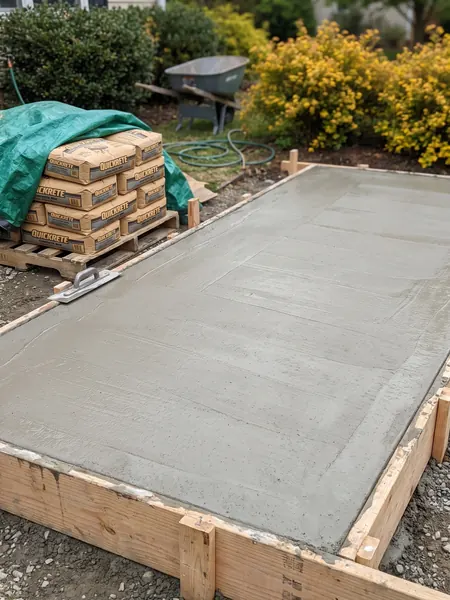
A 10×10 ft slab, 4 inches thick, is 33.3 cubic feet. With 5% extra that's 35 cubic feet, or 59 bags of 80 lb, about 1.3 cubic yards. Concrete is a mix of cement, sand, gravel and water, and it is sold by the cubic yard or in pre-mixed bags.
How to use the concrete calculator
It handles four shapes. Pick the one that matches your pour, enter the size, and it returns cubic yards, bags and the cost. The "How we calculated this" panel shows each step, and the PDF report keeps them for your supplier.
Step 1: Choose the shape
Use slab for a patio, pad or walkway, footing for a strip footing or a thick wall base, round column for a form tube or pier, and post holes for fence or deck posts.
Step 2: Enter the size and thickness
For a slab, enter length, width and thickness. A footing takes length, width in inches and depth in inches. A column takes the diameter, the height and how many you are pouring.
Step 3: Add waste and compare the ways to buy
Choose 0, 5 or 10 percent extra. Enter the price per bag and the ready-mix price per yard to compare. The result shows 80, 60 and 40 lb bags and the yards for delivery.
Concrete for a 100 sq ft slab
| Thickness | Cubic yards | 80 lb bags | 60 lb bags |
|---|---|---|---|
| 4 in | 1.23 yd³ | 56 | 75 |
| 5 in | 1.54 yd³ | 70 | 93 |
| 6 in | 1.85 yd³ | 84 | 112 |
Slab thickness by use
Concrete Network gives 4 inches as typical for residential patios, walkways and driveways. Garage floors and heavy-duty driveways often use 5 to 6 inches, and commercial slabs 6 to 8 inches or more.
| Thickness | One cubic yard covers |
|---|---|
| 4 in | 81 sq ft |
| 5 in | 65 sq ft |
| 6 in | 54 sq ft |
| 8 in | 40 sq ft |
| 12 in | 27 sq ft |
The coverage is 324 ÷ thickness in inches, which is Inch Calculator's rule: a yard covers 81 sq ft at 4 inches and 54 sq ft at 6 inches.
Bag yields
Each concrete bag lists its own yield, so check the label. The table uses the QUIKRETE figures.
| Bag | Yield | Bags per cubic yard |
|---|---|---|
| 80 lb | 0.60 cu ft | 45 |
| 60 lb | 0.45 cu ft | 60 |
| 40 lb | 0.30 cu ft | 90 |
Order a bit extra
Uneven ground, spills and forms that bow out all eat concrete. Inch Calculator recommends adding 5 to 10% so you finish in a single pour and avoid a short load or a cold joint.
Formulas for footings, columns and post holes
- Footing: length (ft) × width (in ÷ 12) × depth (in ÷ 12).
- Round column or tube: π × radius² × height, with the radius in feet.
- Post hole: π × radius² × depth, minus the volume of the post. QUIKRETE's guide sets the hole depth at one-third to one-half of the post height above ground, plus 6 inches for gravel.
Concrete mix types and materials
Concrete is cement, sand, coarse aggregate such as gravel or crushed stone, and water. Bagged concrete comes as a dry mix, and each bag type has its own yield. QUIKRETE's calculator lists three common types.
- Concrete mix: the general-purpose bag for slabs, footings and steps.
- Fast-setting concrete: for fence and deck posts, mixed in the hole.
- Mortar mix: a different material for laying block and brick, not for pours.
Ready-mix is ordered by the cubic yard and arrives by truck. Ask the plant about the mix strength, the delivery fee and the minimum order before you book.
Steps, curbs and walls
For steps, curbs, gutters and walls, split the shape into simple boxes. Work out the volume of each in cubic feet and add them, or run each one through the slab option and add the results.
Square feet, cubic feet and cubic yards
A 10 × 10 ft slab is 100 square feet. Multiply the square feet by the thickness in feet to get cubic feet, and divide by 27 for cubic yards. At 4 inches, 100 square feet is 33.3 cubic feet, or 1.23 cubic yards.
How much does concrete weigh?
Concrete Network says most ready-mix suppliers estimate about 4,000 lb per cubic yard, so a 3 yard order weighs around 12,000 lb. Inch Calculator uses 150 lb per cubic foot, which is 4,050 lb per yard. A cubic yard of concrete weighs about two tons. In metric, one cubic yard is 0.765 cubic meters (NIST).
Bags or ready-mix?
Bags
Best under about one cubic yard (45 bags of 80 lb). No delivery fee, but heavy to carry and mix, and dearer per yard.
Ready-mix
Best past one cubic yard. Small orders may pay a delivery or short-load fee, so ask the plant about its minimum.
Rebar and reinforcement
Concrete Network says standard residential slab grids run #3 or #4 rebar every 12 to 18 inches. Inch Calculator adds that rebar, fiber or steel mesh helps prevent cracking, especially in load-bearing forms. Price the rebar or mesh separately.
Curing and finishing
Concrete Network puts walking on a slab at 24 to 48 hours and full cure at about 28 days. Keep it from drying out during the first 7 to 10 days, when curing matters most.
Concrete cost
Enter your price per 80 lb bag and your ready-mix price per cubic yard. It multiplies each by the amount you need and flags the cheaper option. Add rebar, forms, gravel base and delivery to get the full job cost.
Pouring a patio base or setting pavers instead? Compare with the paver calculator.
Paver calculatorBefore you order concrete
Pick the shape, enter the size, and let the tool turn it into cubic yards and bags with 5 to 10% extra. Compare bags against ready-mix, check the slab thickness for the load, and download the PDF report for your supplier.
Frequently asked questions
How much concrete does an 80 lb bag make?
An 80 lb bag of QUIKRETE Concrete Mix yields about 0.60 cubic feet. That's 45 bags per cubic yard.
How many bags of concrete do I need for a 10x10 slab?
A 10 × 10 ft slab 4 inches thick is 33.3 cubic feet. Concrete Network puts a 4 inch, 100 sq ft slab at 56 bags of 80 lb. With 5% extra the calculator gives 59 bags, about 1.3 cubic yards.
How thick should a concrete slab be?
Concrete Network says 4 inches is typical for patios, walkways and driveways. Garage floors and heavy-duty driveways often use 5 to 6 inches, and commercial slabs 6 to 8 inches or more. Follow local code for anything structural.
How much does a cubic yard of concrete weigh?
Concrete Network says most ready-mix suppliers estimate about 4,000 lb per cubic yard. Inch Calculator uses 150 lb per cubic foot, which is 4,050 lb per cubic yard.
When is ready-mix cheaper than bags?
Past about one cubic yard (45 bags of 80 lb), ready-mix delivery usually wins on price and on labor. Many plants have a minimum order or charge a short-load fee for small pours.
How long does concrete take to cure?
Concrete Network says concrete is dry enough to walk on after 24 to 48 hours, and full curing takes about 28 days. The first 7 to 10 days are the critical period, so keep the surface from drying out.
Is the concrete calculator accurate for footings and columns?
Yes. Choose the footing or round column option, enter the size, and it uses length × width × depth or π × radius² × height. Add 5 to 10% for uneven ground and spills.
Sources