On this page
- How much paver base do I need?
- How to use the paver base calculator
- How thick should paver base be?
- Paver base in tons by area and depth
- What gravel to use for paver base
- Compacting the base
- Geotextile and wet soils
- Paver base, bedding sand and pavers
- Bags or bulk paver base
- Common paver base mistakes
- Before you order paver base
- Frequently asked questions
How much paver base do I need?
Take the area × the compacted base depth for cubic yards, add extra for compaction, and convert to tons at about 1.4 tons per yard. A 12 × 16 ft patio with a 4 inch base needs about 3.8 tons.
Worked example: 12 × 16 ft = 192 sq ft. At 4 inches that is 64 cubic feet, or 2.37 yd³. Add 15% for compaction: 2.73 yd³. Multiply by 1.4 tons per yard and you order about 3.8 tons of base material.
How to use the paver base calculator
The paver base calculator runs the formula above; every step appears in "How we calculated this" and in the PDF report.
Step 1: Enter the patio, walkway or driveway size
Type the length and width in feet, or the square feet. Measure a little wider than the pavers, so the edge restraint sits on compacted base rather than soil.
Step 2: Pick the compacted base depth
4 inches for patios and walkways, 6 for driveways, 8 or 10 inches for cold climates and wet or clay soil, the ICPI Tech Spec 2 minimums.
Step 3: Set the compaction allowance in the paver base calculator
Loose gravel loses volume under the plate compactor. The default adds 15%; change it to your supplier's figure.
Step 4: Compare bags and bulk
Enter the price per 50 lb bag and per ton. The result shows both, marks the cheaper one, and gives the volume in cubic yards and cubic feet.
How thick should paver base be?
ICPI Tech Spec 2 bases the thickness on traffic, soil, drainage and climate. These are the minimum compacted thicknesses over well-drained soils:
| Use | Minimum base | Cold climate or wet/weak soil |
|---|---|---|
| Sidewalks, patios, pedestrian areas | 4 in | 6–8 in |
| Residential driveways | 6 in | 8–10 in |
| Residential streets | 8–10 in | More, per local standards |
Extend the base past the edge
Excavate and build the base a little wider than the pavers so the edge restraint sits on compacted stone, not soil. Add that strip to the area you enter.
Paver base in tons by area and depth
Tons at 1.4 tons per cubic yard with 15% for compaction, the paver base calculator's defaults.
| Area (sq ft) | 4 in base | 6 in base | 8 in base | Cubic yards (4 in, no extra) |
|---|---|---|---|---|
| 100 | 1.99 t | 2.98 t | 3.98 t | 1.23 yd³ |
| 250 | 4.97 t | 7.45 t | 9.94 t | 3.09 yd³ |
| 500 | 9.94 t | 14.91 t | 19.88 t | 6.17 yd³ |
| 1,000 | 19.88 t | 29.81 t | 39.75 t | 12.35 yd³ |
| 2,000 | 39.75 t | 59.63 t | 79.51 t | 24.69 yd³ |
What gravel to use for paver base
Paver base is a dense-graded crushed aggregate: angular stone from about 1½ inches down to fines, so the small pieces fill the gaps between the large ones and the layer compacts hard. Suppliers sell it as paver base, crusher run, road base or by a DOT number.
ICPI says local city or state base specifications for asphalt roads are adequate; if there are none, it gives this gradation (ASTM D2940):
| Sieve | Base: % passing (ICPI Table 4) |
|---|---|
| 2 in (50 mm) | 100 |
| 1½ in (37.5 mm) | 95–100 |
| ¾ in (19 mm) | 70–92 |
| ⅜ in (9.5 mm) | 50–70 |
| No. 4 (4.75 mm) | 35–55 |
| No. 30 (600 µm) | 12–25 |
| No. 200 (75 µm) | 0–8 |
Rounded stone such as pea gravel or river rock never locks together and should not be used as a base. Clean crushed stone with no fines, such as #57, drains well but needs an open-graded system designed for permeable pavers.
Recycled concrete aggregate
ICPI allows up to 100% recycled concrete aggregate under pedestrian pavements, with an increased risk of efflorescence on the paver surface. For vehicular areas it recommends no more than 50% mixed with quarried stone, from DOT-certified sources.
Compacting the base
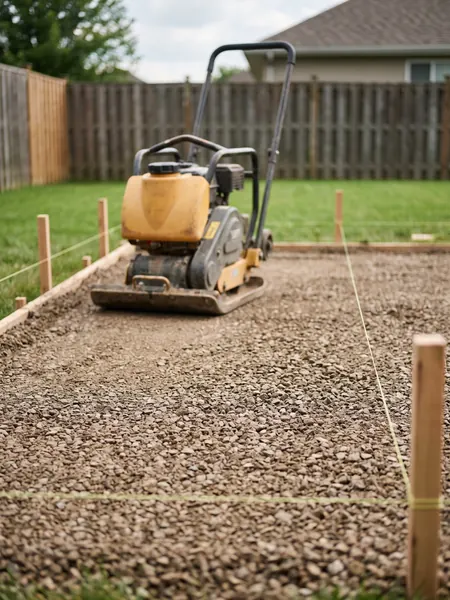
Spread and compact the base in 4 to 6 inch lifts with a 7,000 lbf reversible plate compactor, or thinner lifts with a 5,000 lbf machine, per ICPI. Patios and residential driveways should reach at least 98% of standard Proctor density, at optimum moisture.
The finished base should be within ± 3/8 in under a 10 ft straightedge. Fix low spots in the base itself: ICPI says the bedding sand must never be used to level an uneven base.
Geotextile and wet soils
ICPI lists geotextile as optional, for soils that stay saturated or contain a lot of fines. It keeps soil from migrating up into the base, which reduces rutting. Overlap the rolls at least 12 inches downslope. On clay, add drain pipe along the perimeter where water collects.
Paver base, bedding sand and pavers
The base carries the load; the 1 inch bedding sand only seats the pavers. Use the paver sand calculator for the sand and the paver calculator for the pavers, base and sand together. Some patio kits use plastic base panels instead of gravel; follow the maker's instructions for those.
Bags or bulk paver base
A 50 lb bag is 1/40 of a ton, so a 4 inch patio base of 3.8 tons would take 152 bags. Bags suit a walkway or a repair; for anything larger, bulk delivery by the ton is cheaper. Ask about the minimum load and the delivery fee.
Common paver base mistakes
- Base too thin for the soil or the traffic.
- One thick lift instead of 4 to 6 inch lifts, compacted one by one.
- No compaction allowance, so the order runs short.
- Leveling with sand instead of fixing the base.
Before you order paver base
Enter the area and the depth for your project, keep a compaction allowance, and let the paver base calculator turn it into tons, cubic yards and bags. Confirm the product and its weight per yard with your supplier, and download the PDF report to take with you.
Frequently asked questions
How thick should paver base be?
ICPI Tech Spec 2: at least 4 inches of compacted base under sidewalks, patios and pedestrian areas, and at least 6 inches under residential driveways, over well-drained soils. Colder climates and wet or weak soils need 2 to 4 inches more.
What gravel is used for paver base?
A dense-graded crushed aggregate that compacts hard, often sold as paver base, crusher run or road base. ICPI Tech Spec 2 gives a gradation from 2 in down to fines; local DOT base specifications for asphalt roads are also adequate.
How much paver base do I need for a 10×10 patio?
At 4 inches compacted: 1.23 cubic yards. With 15% extra for compaction that is 1.42 yd³, about 2 tons at 1.4 tons per yard.
How much does paver base shrink when compacted?
Loose base loses volume when it is compacted, which is why the paver base calculator adds an allowance. Our default is 15%; ask your supplier for the figure they use for their product.
How many bags of paver base per ton?
40 bags of 50 lb make a ton. Bags suit small repairs and walkways; for a patio, bulk base by the ton is far cheaper.
Can I use recycled concrete as paver base?
ICPI allows up to 100% recycled concrete aggregate under pedestrian pavements, with a higher risk of efflorescence on the pavers, and no more than 50% mixed with quarried stone for vehicular areas, from DOT-certified sources.
Do I need sand on top of the paver base?
Yes. The base is compacted gravel; the pavers sit on a 1 inch layer of bedding sand screeded over it. Use the paver sand calculator for that layer.
Sources